A viva prep template for Notion that tells you what to drill next
Build a bank of the questions you are likely to be asked, plan each answer in four short notes, rehearse out loud, and let the studio rank which question needs work next.
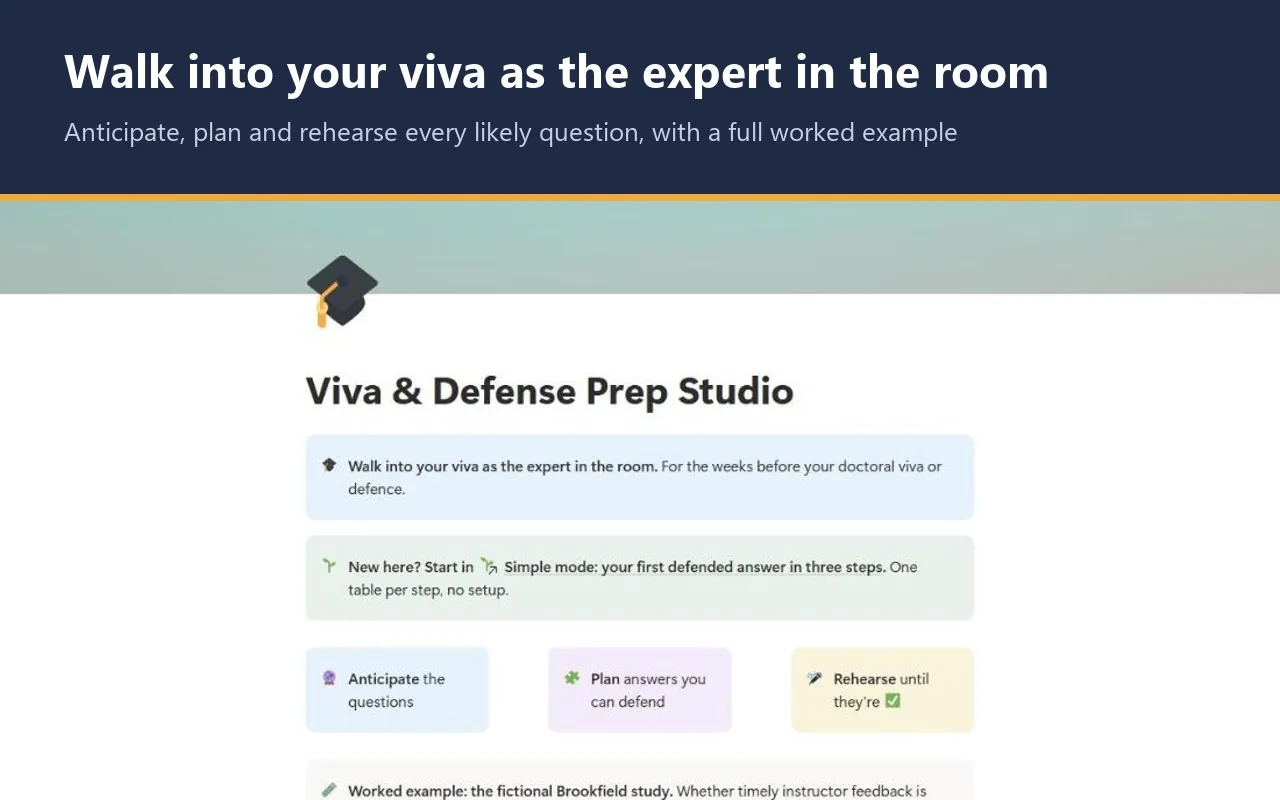
For doctoral candidates in the weeks before a viva or dissertation defence, and for master's students facing an oral examination.
- Anticipate → Plan → Rehearse
- Simple mode
- Works on Notion's Free plan
- Worked example
$15
One-time price. Checkout on Gumroad; an instant PDF with your link to duplicate the studio.
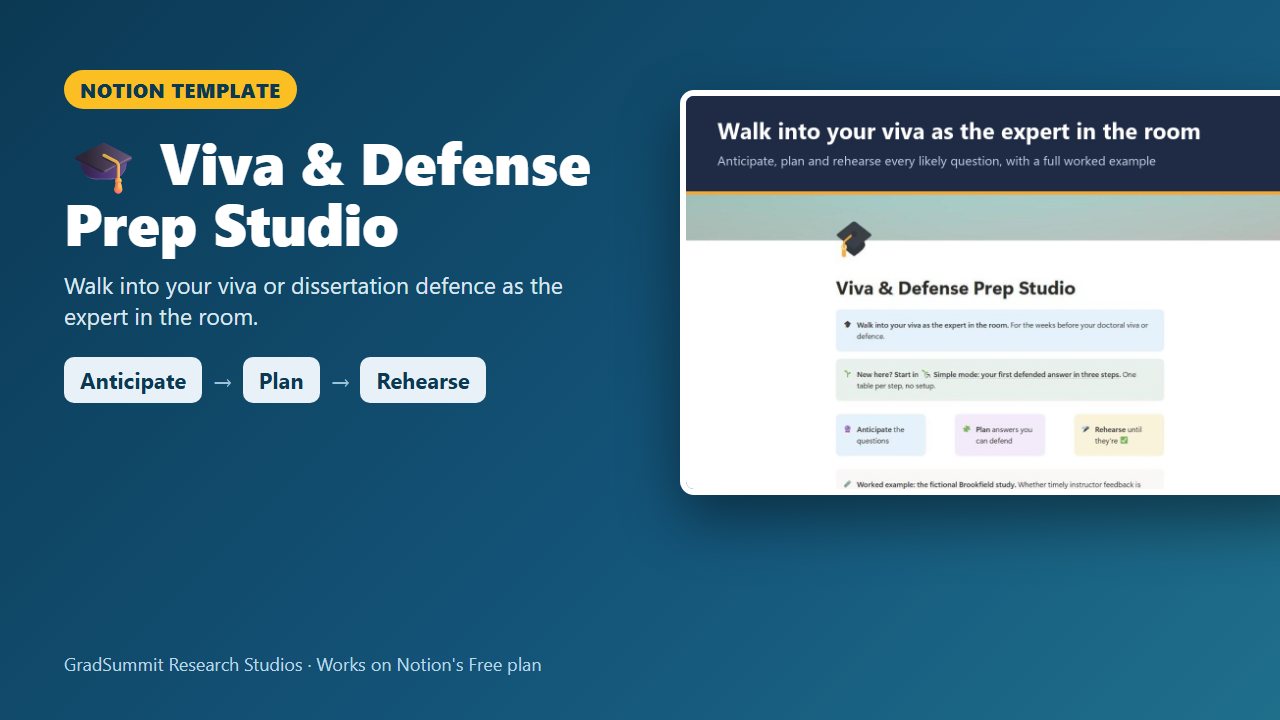
See inside the Viva & Defense Prep Studio
The problem it solves
Most candidates prepare for a viva by rereading the thesis. That helps you remember what you wrote. It does not prepare you to answer "Why this design?" or "What is your original contribution?" out loud, in two minutes, to someone who has read the thesis closely.
Viva questions are more predictable than they feel. Examiners' questions cluster around a few recurring themes: the contribution, the design, the findings, the limitations, the literature and what comes next (Trafford & Leshem, 2002). And experienced examiners expect a thesis to pass and read it hoping it will (Mullins & Kiley, 2002).
The problem is knowing where to spend the last few weeks. A list of 100 common viva questions does not tell you which ones are likely for your thesis, or which of your answers is still weak. You end up rehearsing the questions you already answer well, because they feel good to practise.
This studio keeps your questions, your answer plans and your rehearsal scores in one place, and ranks the questions so the weakest likely ones rise to the top.
How it works: Anticipate → Plan → Rehearse
Anticipate
Build a bank of the questions you are likely to be asked. Tag each by its kind, such as contribution, methodology, findings or limitations, by how likely it is (High, Medium or Low) and by the chapter it probes.
Plan
Sketch each answer in four short notes: acknowledge the question, respond, point to the evidence, and engage the examiner. Record the pages, tables and sections you will point to.
Rehearse
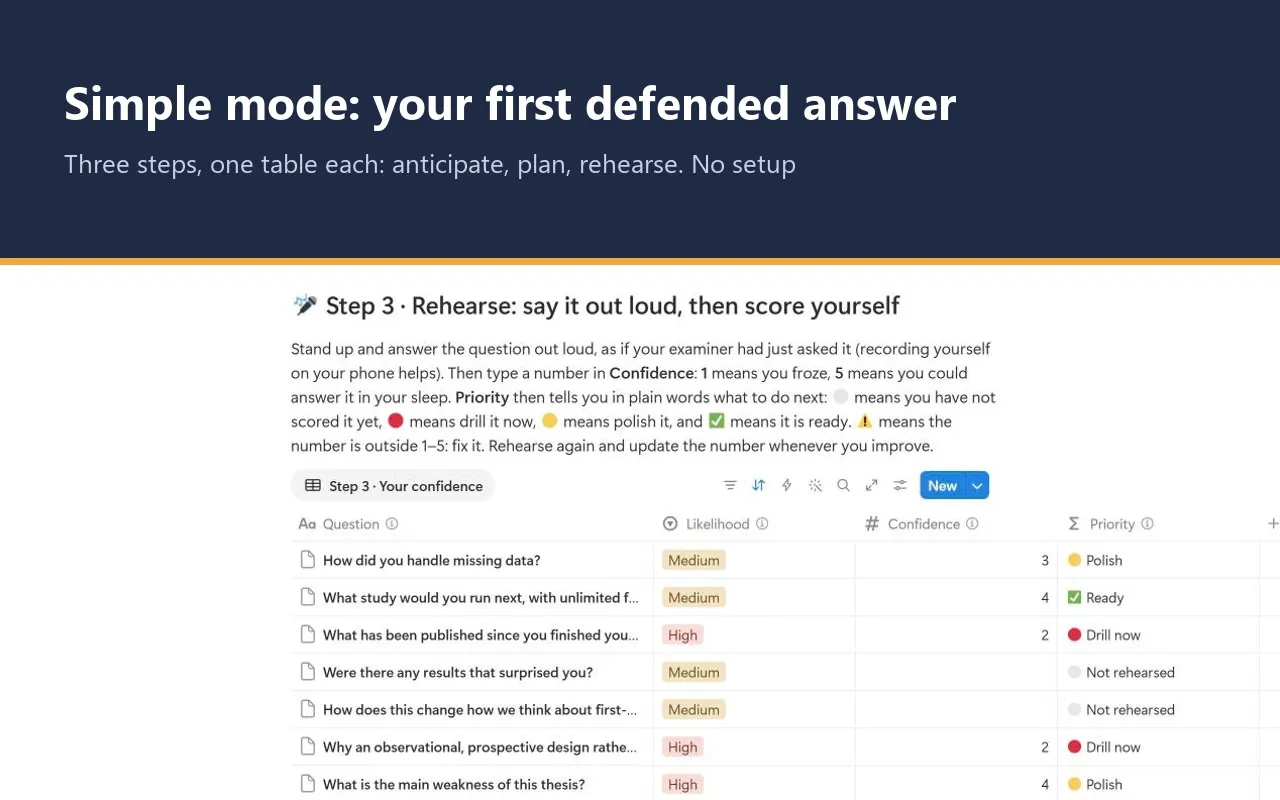
Answer out loud, as if the examiner had just asked. Score your confidence from 1 (you froze) to 5 (you could answer it in your sleep), and update the score each time you improve.
What the studio checks for you
Each question and each chapter carries a plain-language status, worked out by formulas from your likelihood and confidence scores. These are the labels you will see.
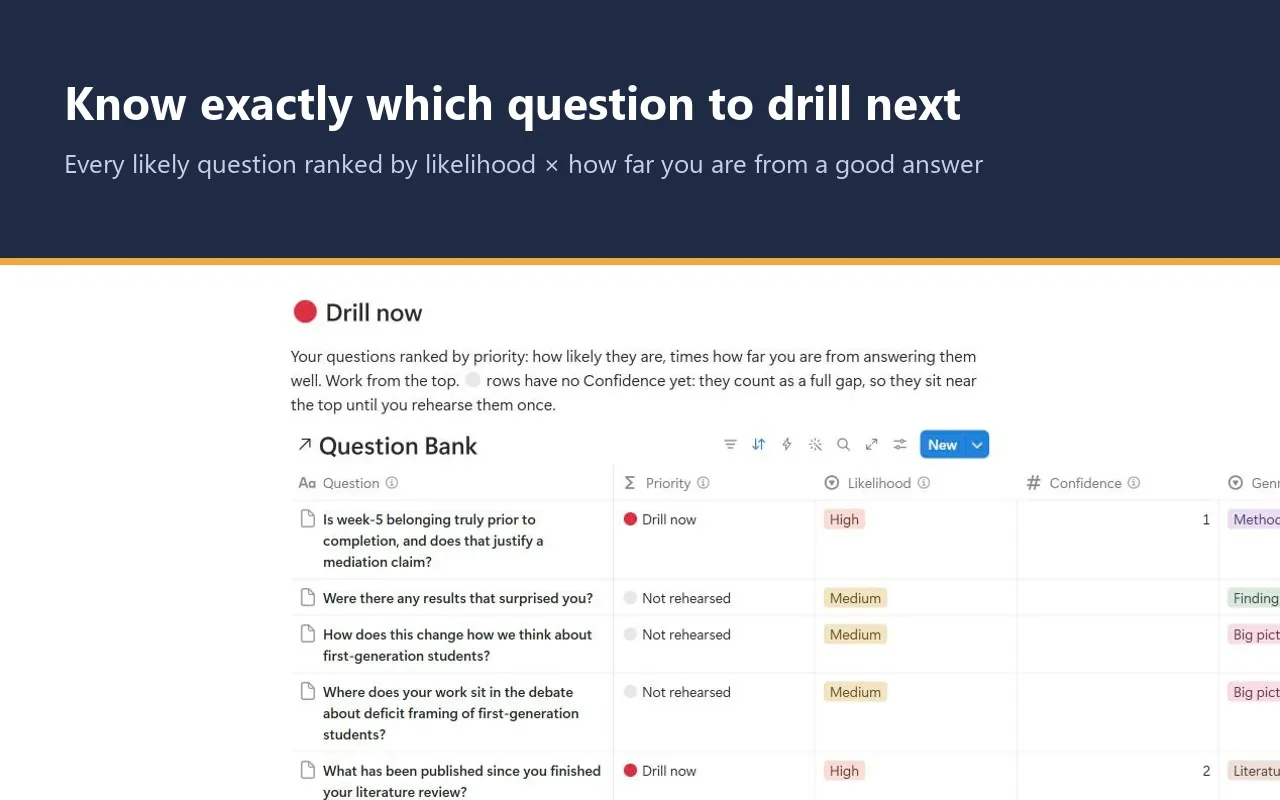
Priority, per question
- ⚪ Not rehearsed: no confidence score yet. It counts as a full gap, so it sits near the top of Drill now until you rehearse it once.
- 🔴 Drill now: likely and still far from a good answer.
- 🟡 Polish: close, but worth another run.
- ✅ Ready: you can answer it well, or it is unlikely enough to leave.
- ⚠️ Use 1–5: the confidence score is outside 1 to 5. It is flagged and left out of the chapter average rather than quietly counted.
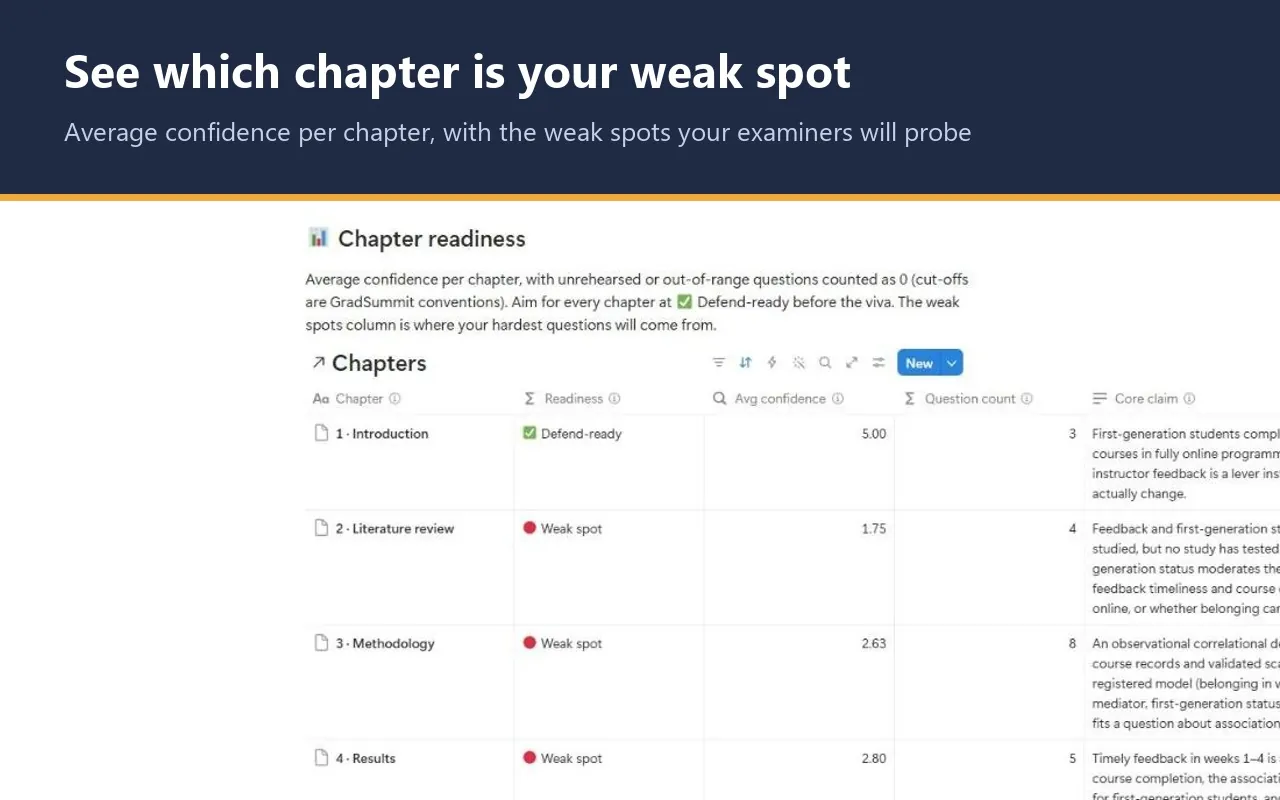
Readiness, per chapter
- ⚪ No questions yet: no questions are linked to the chapter.
- ⚪ Not rehearsed yet: questions are linked, but none is scored.
- 🔴 Weak spot: average confidence below 3.
- 🟡 Getting there: average confidence from 3 to 3.9.
- ✅ Defend-ready: average confidence of 4 or more.
Priority is likelihood (High 3, Medium 2, Low 1) times the gap between your confidence and 5. A score of 6 or more is 🔴, 3 to 5 is 🟡. The chapter average counts unrehearsed questions as 0. The weights and cut-offs are GradSummit conventions, not published standards, and the studio says so.
The worked example
Fictional study
The worked example is the fictional Brookfield thesis: a prospective, observational study of whether timely instructor feedback is linked to course completion among first-generation students in fully online programmes. It has 6 chapters, a three-person panel, 30 questions across 9 kinds, 3 rehearsals and 3 errata. Drill now shows 12 questions at 🔴, 4 at 🟡, 10 at ✅ and 4 not yet rehearsed. The top question asks whether belonging measured in week 5 justifies a mediation claim. Chapter readiness shows the Introduction ✅ Defend-ready, the Discussion 🟡 and four chapters 🔴, with Methodology carrying 8 of the 30 questions. Clearing the example takes a few minutes.
Method and sources
The studio draws on research on doctoral examination. Trafford & Leshem (2002) show that examiners' questions cluster around predictable themes, which is what the question kinds follow. Mullins & Kiley (2002) found that experienced examiners expect a thesis to pass. Wellington (2010) suggests that knowing what to expect, and rehearsing, can reduce anxiety. Full references are on the answer method page.
The answer method page sets out the four notes with examples, and a viva-day checklist runs from four weeks out to after the viva. Anticipate, Plan, Rehearse is GradSummit's shorthand, not a published framework. A short section covers US-style dissertation defences.
What the studio does not do
- It does not predict your examiners' questions. It helps you prepare for the likely ones on purpose.
- The confidence scores are your own judgement. The ranking is only as honest as the numbers you type.
- Viva and defence formats vary. Always follow your own institution's rules and your supervisor's advice.
- It does not write your answers. The four notes are prompts for answers in your own words.
What you get
- A one-page PDF with your private link, sent by Gumroad straight after checkout. Click it, then Duplicate, and the studio is in your own Notion workspace, yours to keep.
- Simple mode: three steps, one small table each, with a plain instruction above every table. You can start in Notion for the first time today.
- Drill now, Chapter readiness, your examiners linked to the questions they may ask, a rehearsal log for solo, peer and mock vivas, and a corrections and errata tracker for before and after the viva.
- Export views that turn your question bank, rehearsals and corrections into clean CSV tables.
- A Start here page, the answer method with full references, a viva-day checklist, and a worked fictional example you can clear in a few minutes.
- Works on Notion's Free plan. No charts, no paid features and no Notion AI needed.
Questions
Does it work for a US dissertation defense as well as a UK viva?
Yes. The questions, answer plans and rehearsal scores work for both. The studio includes notes for US-style defences. Formats vary by institution, so follow your own rules.
How is this different from a list of common viva questions?
A list gives you the same questions as everyone else. Here you add the questions likely for your thesis, plan each answer, score yourself after each rehearsal, and the studio ranks what to drill next. For general advice on the day itself, read the thesis defense guide.
Will I get updates?
The link in your PDF points to the published studio, so if it is updated you can duplicate the current version again. Your own copy never changes underneath you, which matters halfway through your viva preparation.
Does it work on Notion's Free plan?
Yes. The studio uses ordinary databases, relations, rollups and formulas. It needs no charts, no paid Notion features and no Notion AI, so the Free plan is enough.
How do I get the studio after I pay?
Checkout is on Gumroad. Straight after you pay $15, you get a one-page PDF with your private link. Open the link, click Duplicate, and the studio is copied into your own Notion workspace. It is yours to keep.
What if the link does not work or something is wrong?
Digital products cannot be returned once delivered, but if the link does not work or something is wrong with the studio, email rafiq@gradsummit.com and we will fix it or refund you.
Can my research group or class use it?
Each purchase is for one person. For a class or research group, email rafiq@gradsummit.com about a group licence.
Related guides and templates
Other research studios
Viva & Defense Prep Studio
Anticipate → Plan → Rehearse, with a worked example and a method guide. $15, one-time.
Viva & Defense Prep Studio by Rafiq Muhammad, MD, MIHMEP, PhD (GradSummit). The example study and all its data are fictional and created for teaching.
Notion is a trademark of Notion Labs, Inc. GradSummit is not affiliated with or endorsed by Notion.