A thematic analysis template for Notion, from first code to defensible theme
Code your interviews, give each code a clear definition, cluster codes into themes, and check each theme is ready before you write it up, with the quotes and the audit trail behind it.
For master's and doctoral students and early-career researchers doing interview or focus group research with thematic analysis, reflexive or codebook, or a similar coding-based approach.
- Code → Cluster → Claim
- Simple mode
- Works on Notion's Free plan
- Worked example
Free
Free on Gumroad: enter your email and get a one-page PDF with your link to duplicate the studio. On the Notion Marketplace soon.
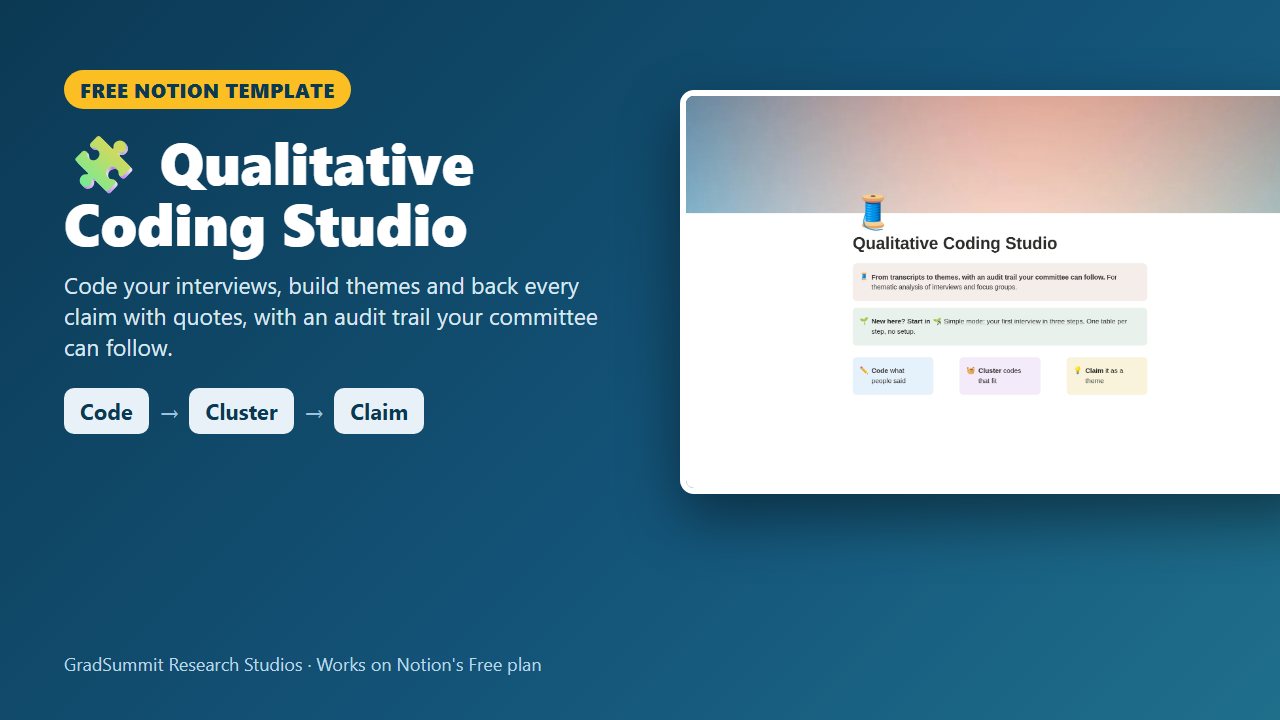
See inside the Qualitative Coding Studio
The problem it solves
Qualitative analysis usually ends up spread across Word comments, highlighter colours and a spreadsheet nobody else can follow.
The questions that catch students out are predictable. What does this code mean? Why is this a theme and not just a topic? Does it hold across participants, or rest on one vivid interview?
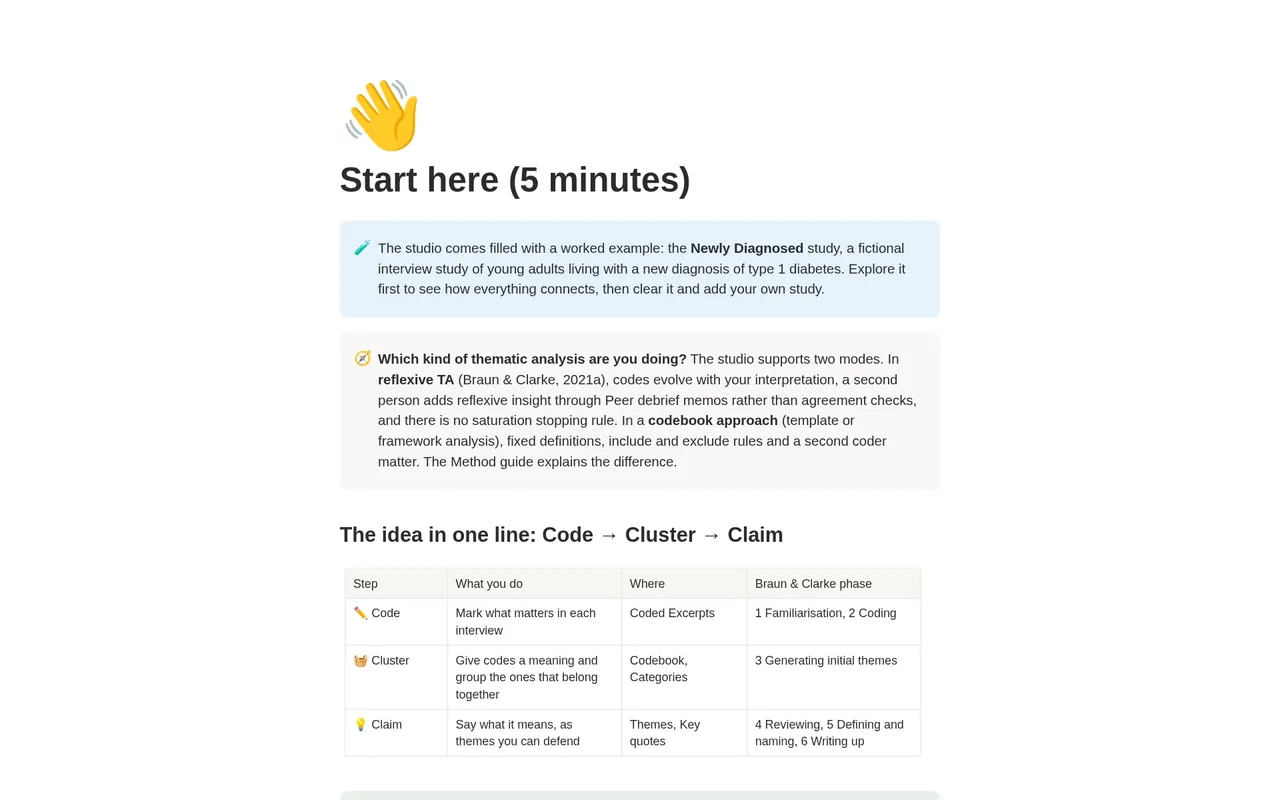
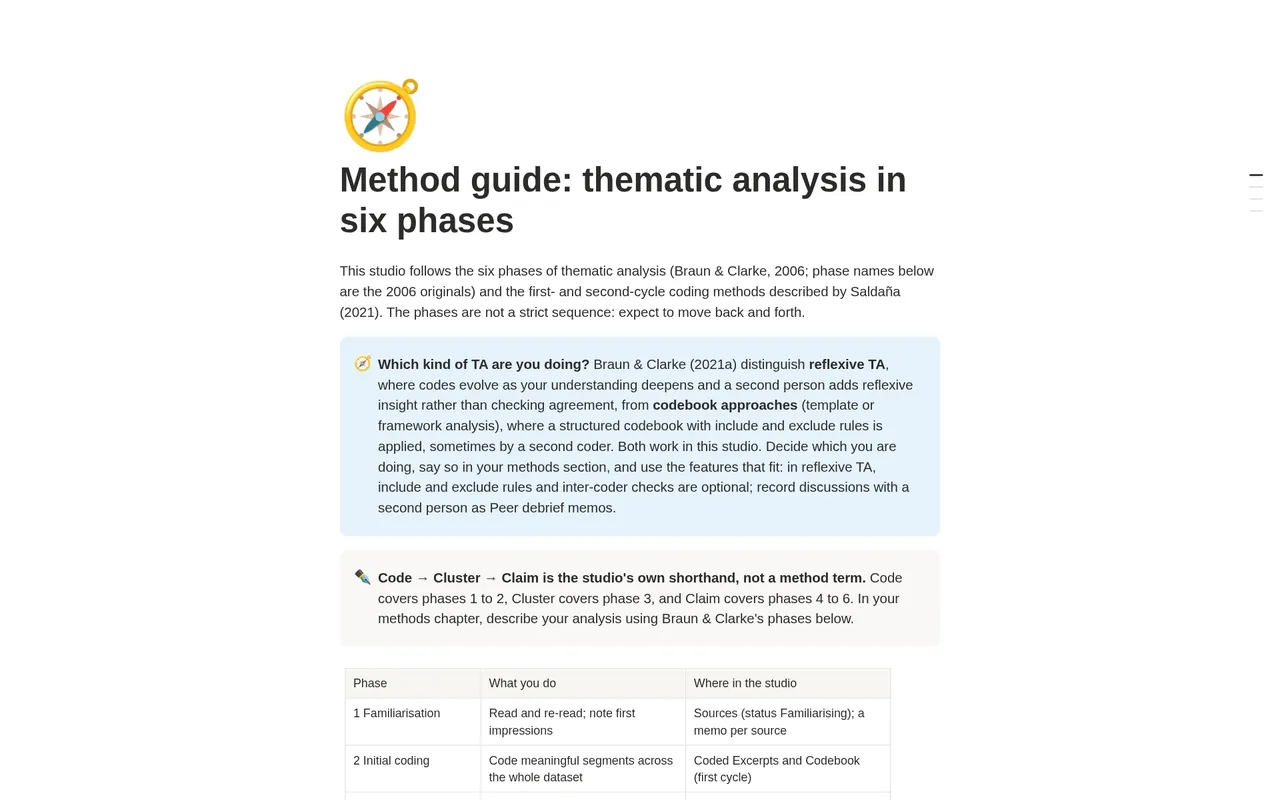
That last one matters more than it looks. Braun & Clarke (2021a) separate reflexive thematic analysis, where codes evolve with your interpretation and a second person adds insight rather than checking agreement, from codebook approaches such as template or framework analysis. Mixing the language of the two in one methods chapter is a weakness an examiner will spot.
This studio keeps the whole process in one connected workspace and records it as you go, so the evidence for each theme is already there when you write.
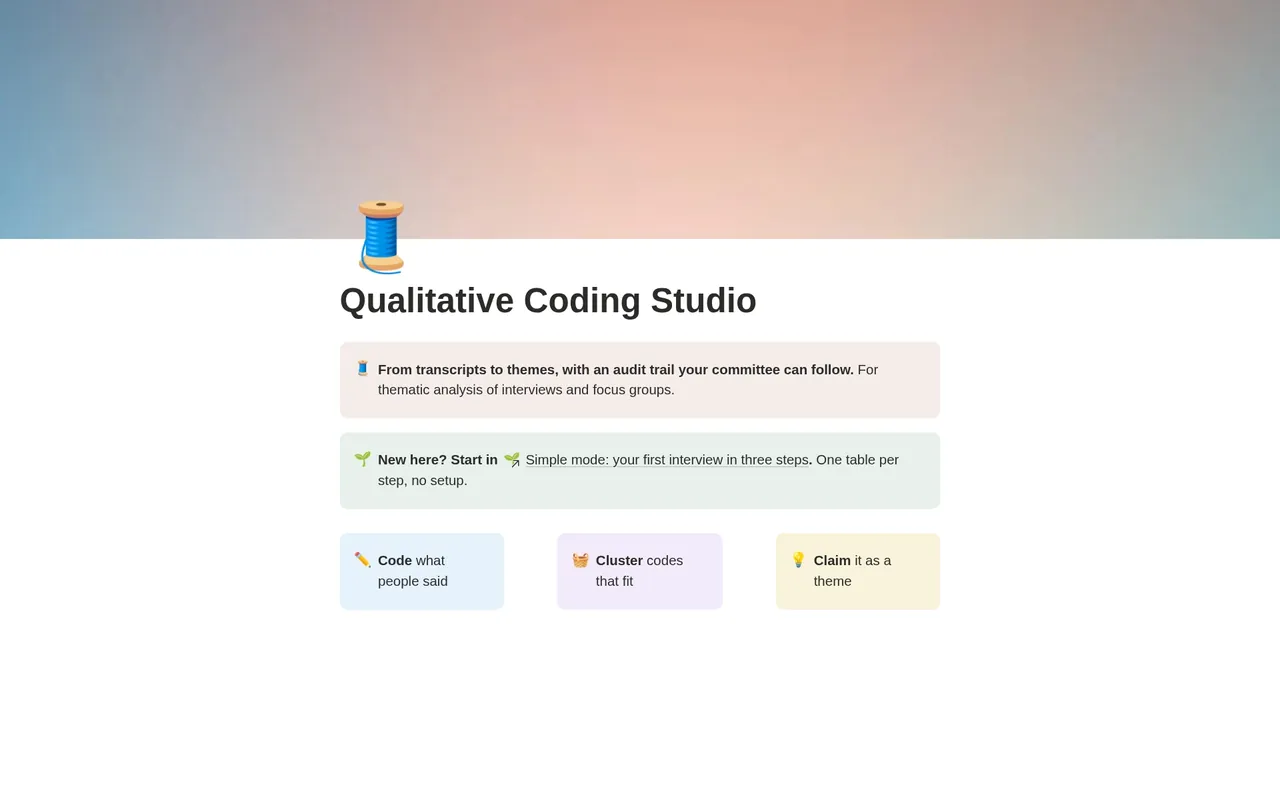
How it works: Code → Cluster → Claim
Code
Read an interview and mark what matters. Each excerpt keeps its short quote, the source it came from and the codes you give it. A new code typed into a quote becomes a codebook entry automatically.
Cluster
Give each code a one-line definition, note the source where it first appeared, and group the codes that belong together into categories. Include and exclude rules are there if you use a codebook approach.
Claim
Write each theme as a claim, link the categories and key quotes behind it, and tick the four checks: coherent, distinct, evidenced across sources and answering your research question.
What the studio checks for you
Each code and each theme carries a plain-language status, worked out by formulas from what you have entered. These are the labels you will see.
Definition check, per code
- ⚠️ Add a one-line definition: the code has a label but no description yet.
- ✅ Defined: the code has a definition, which is enough for reflexive thematic analysis.
- ✅ Defined, with include and exclude rules: the code also has the rules a codebook approach needs.
Readiness, per theme
- ⚪ New theme: tick the four checks and link 2 key quotes: nothing has been assessed yet.
- 🟠 2 of 4 checks pass · link 1 more key quote(s): some checks still fail, and the status says how many pass and how many quotes are missing.
- 🟡 Checks pass: link 1 more key quote(s): all four checks pass, but the theme does not yet have two key quotes behind it.
- ✅ Ready to write up: all four checks pass and at least two key quotes are linked.
Code development, per source
- New codes: how many codes first appeared in each source. Only sources you have marked Coded or Peer-checked are counted, so an uncoded interview never looks like a source with nothing new.
The two-quote rule is the studio's own readiness threshold for when a theme is ready to draft, not a published standard, and prevalence alone does not make a theme important. The code development count is a record of how your coding grew, not a stopping rule: in reflexive thematic analysis, saturation does not apply in that way (Braun & Clarke, 2021b), and the method guide explains why.
The worked example
Fictional study
The studio comes filled with a fictional worked example, the Newly Diagnosed study: an interview study of young adults living with a new diagnosis of type 1 diabetes. It has 8 sources, 14 codes, 25 coded excerpts and 4 themes. Six sources are coded and two are not yet coded. Two themes show ✅ Ready to write up and two are still being refined, one with three of its four checks passing and one with a single check and a missing key quote. Clearing the example takes about two minutes.
Method and sources
The studio follows the six phases of thematic analysis (Braun & Clarke, 2006) and Braun & Clarke's later distinction between reflexive and codebook approaches (2021a), with the first and second cycle coding methods described by Saldaña (2021). Code, Cluster and Claim are the studio's own shorthand: Code covers phases 1 and 2, Cluster phase 3, and Claim phases 4 to 6. In your methods chapter, describe your analysis in Braun & Clarke's terms.
The method guide also covers sample adequacy: Hennink et al. (2017) on code and meaning saturation, Braun & Clarke (2021b) on why saturation does not fit reflexive thematic analysis, and information power (Malterud et al., 2016). A trustworthiness checklist draws on Lincoln & Guba (1985) and Nowell et al. (2017).
What the studio does not do
- It does not code for you, and it never creates themes. Interpretation is your job, as Braun & Clarke insist.
- It does not judge the quality of your codes or themes. The checks make your judgement visible; they do not replace it.
- It is not qualitative data analysis software. You paste short excerpts, not whole transcripts, and it does not handle audio or code automatically.
What you get
- A one-page PDF with your link, sent by Gumroad when you click Get it free and enter your email. Click it, then Duplicate, and the studio is in your own Notion workspace, yours to keep.
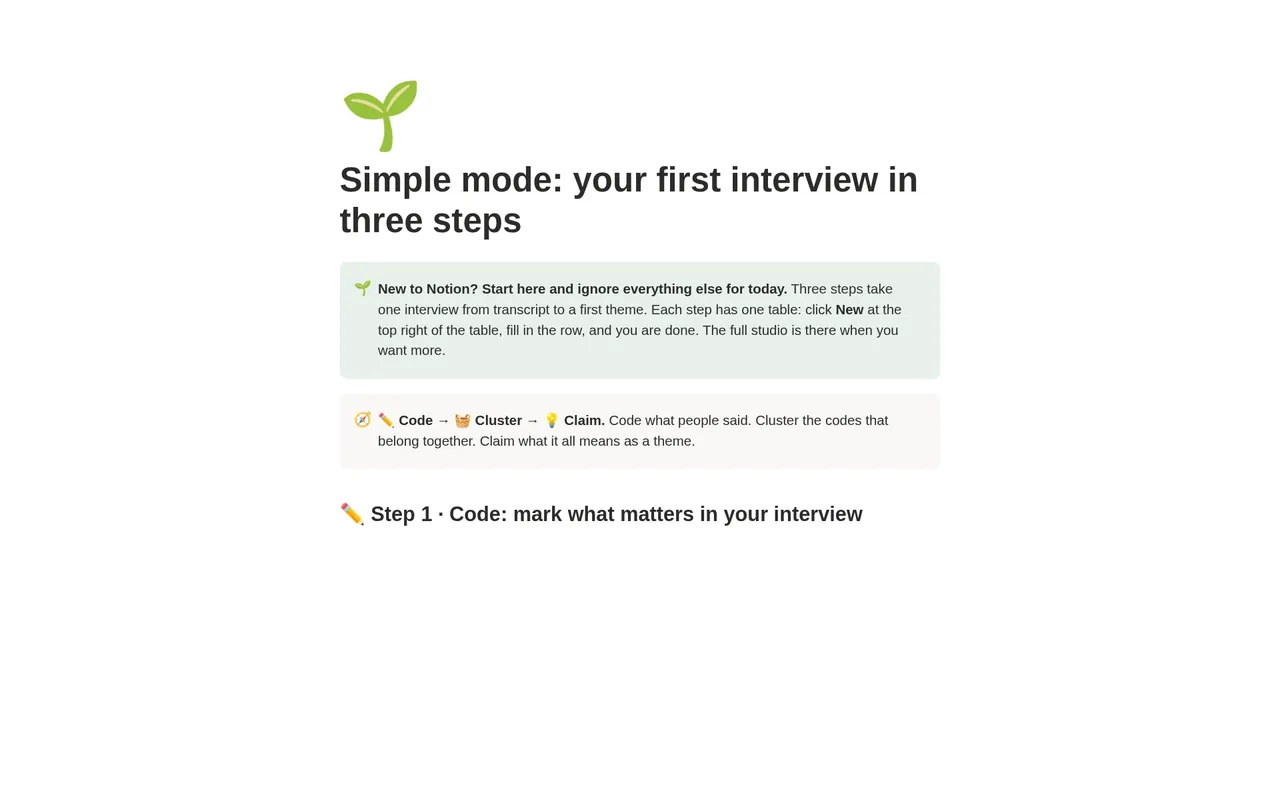
- Simple mode: three steps, one small table each, with a plain instruction above every table. You can start in Notion for the first time today.
- Six linked databases: sources with a coding queue, a living codebook, categories, coded excerpts, themes with a readiness check, and an audit trail of memos, reflexive entries and decisions tagged by phase.
- A key quotes gallery for your findings chapter, and export views that turn your codebook and quotes into clean CSV tables for an appendix.
- A Start here page, a method guide with full references, and a worked fictional example you can clear in a few minutes.
- Works on Notion's Free plan. No charts, no paid features and no Notion AI needed.
Questions
Does it suit reflexive thematic analysis or a codebook approach?
Both. In reflexive thematic analysis a one-line definition is enough, a second person adds insight through peer debrief memos rather than agreement checks, and the code development count is a record, not a stopping rule. In a codebook approach such as template or framework analysis, you can add include and exclude rules to every code. Decide which you are doing and say so in your methods section; the method guide explains the difference.
Is it qualitative data analysis software?
Not in the full sense. It has no audio and no automatic coding, and you work with short excerpts. For a small or medium interview study, it keeps your codebook, themes and quotes in one place.
Will I get updates?
The link in your PDF points to the published studio, so if it is updated you can duplicate the current version again. Your own copy never changes underneath you, which matters halfway through an analysis.
Does it work on Notion's Free plan?
Yes. The studio uses ordinary databases, relations, rollups and formulas. It needs no charts, no paid Notion features and no Notion AI, so the Free plan is enough.
Is it really free? How do I get it?
Yes. Click Get it free and Gumroad asks for your email address; the price is $0. You then get a one-page PDF with the link. Open the link, click Duplicate, and the studio is copied into your own Notion workspace. It is yours to keep. It is also with Notion for review and will appear on the Notion Marketplace soon.
What if the link does not work or something is wrong?
Email rafiq@gradsummit.com and we will fix it.
Related guides and templates
Other research studios
Qualitative Coding Studio
Code → Cluster → Claim, with a worked example and a method guide. Free.
Qualitative Coding Studio by Rafiq Muhammad, MD, MIHMEP, PhD (GradSummit). The example study and all its data are fictional and created for teaching.
Notion is a trademark of Notion Labs, Inc. GradSummit is not affiliated with or endorsed by Notion.