An interview guide template for Notion, from first draft to transcript
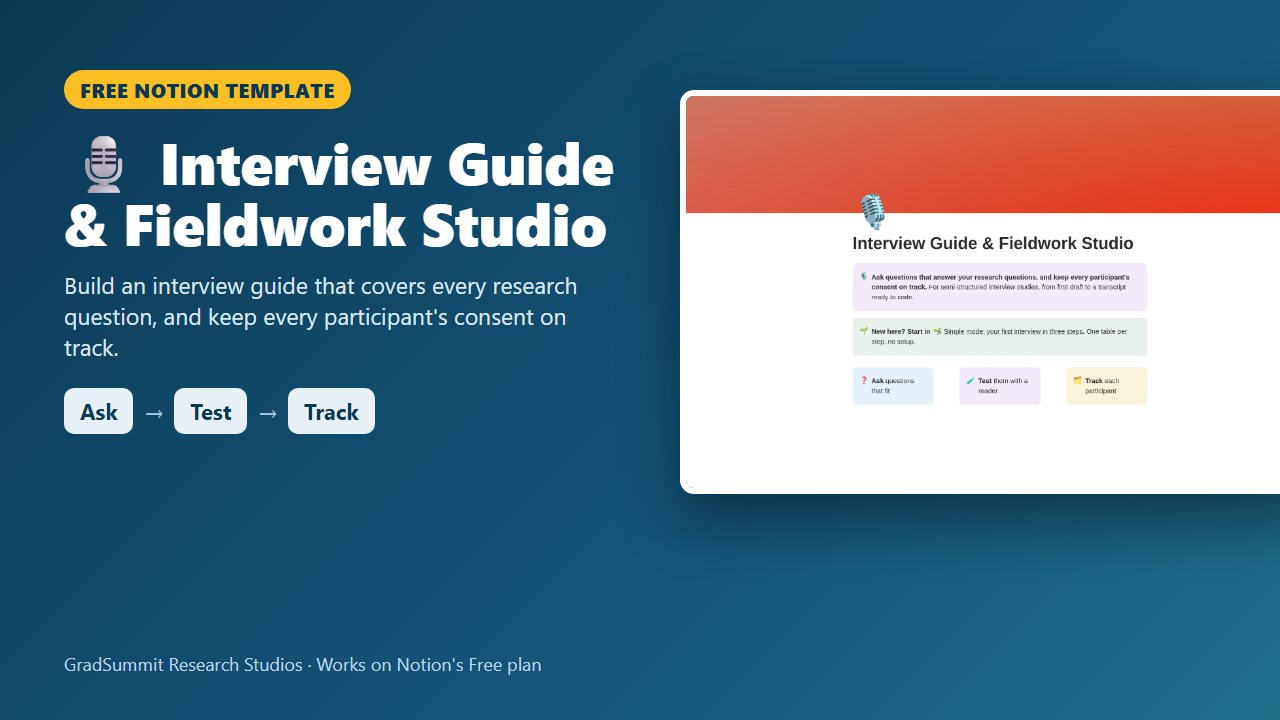
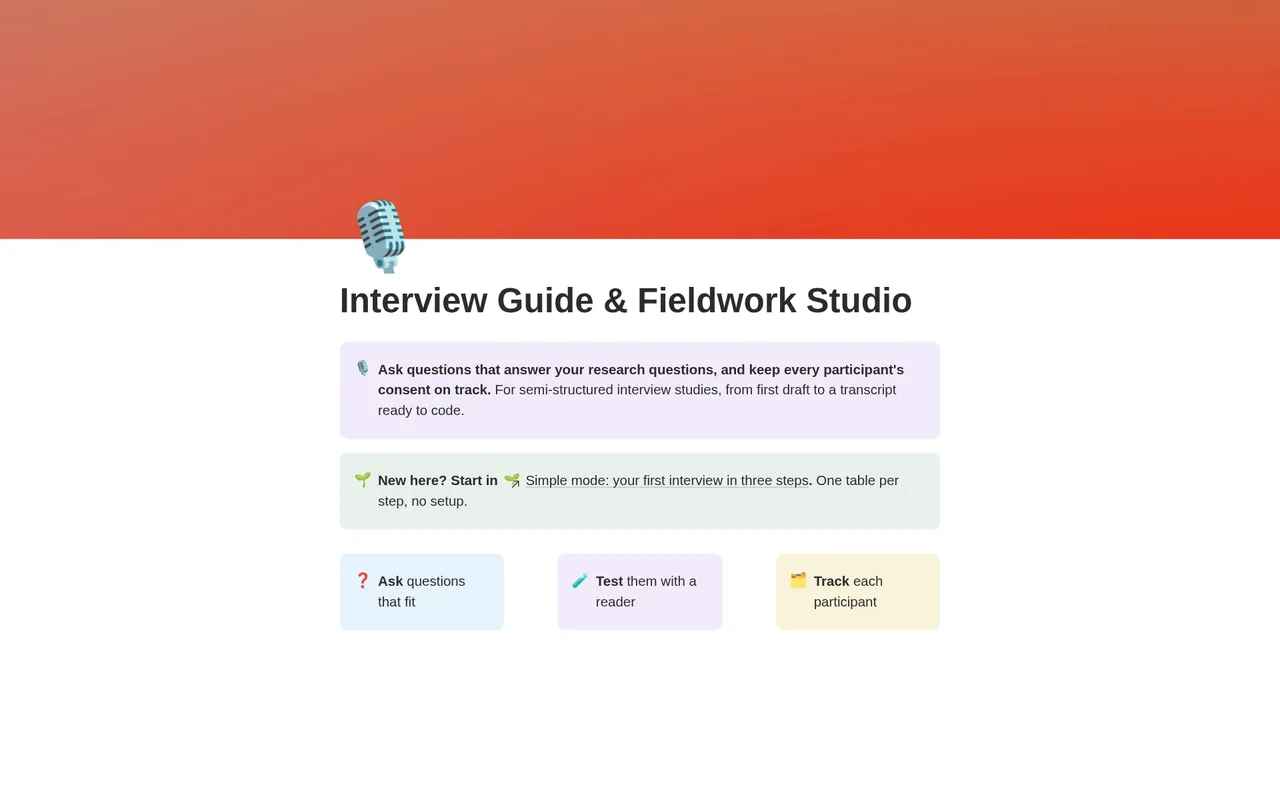
Write questions that reach every research question, test their wording with a second reader, and move each participant from first contact to a consented, anonymised transcript that is ready to code.
For master's and doctoral students and early-career researchers running a semi-structured interview study, from ethics approval to the last transcript.
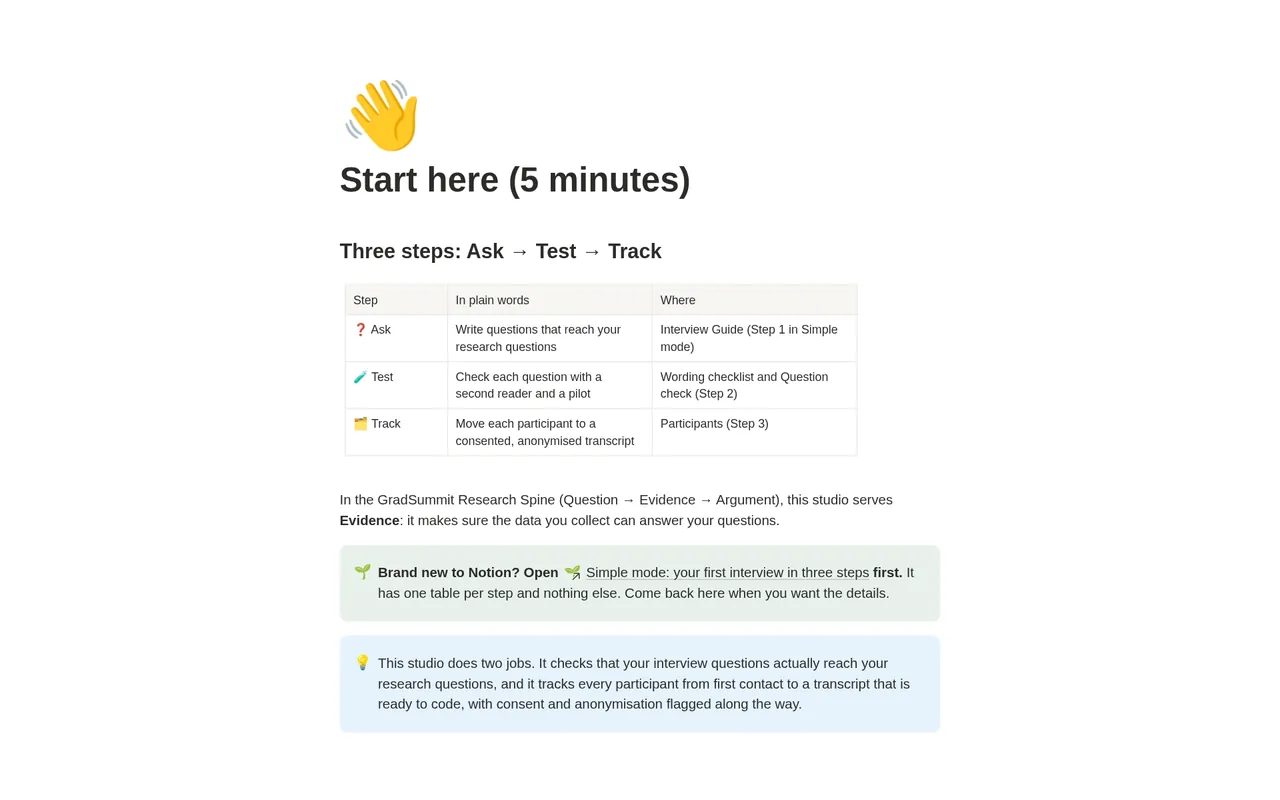
- Ask → Test → Track
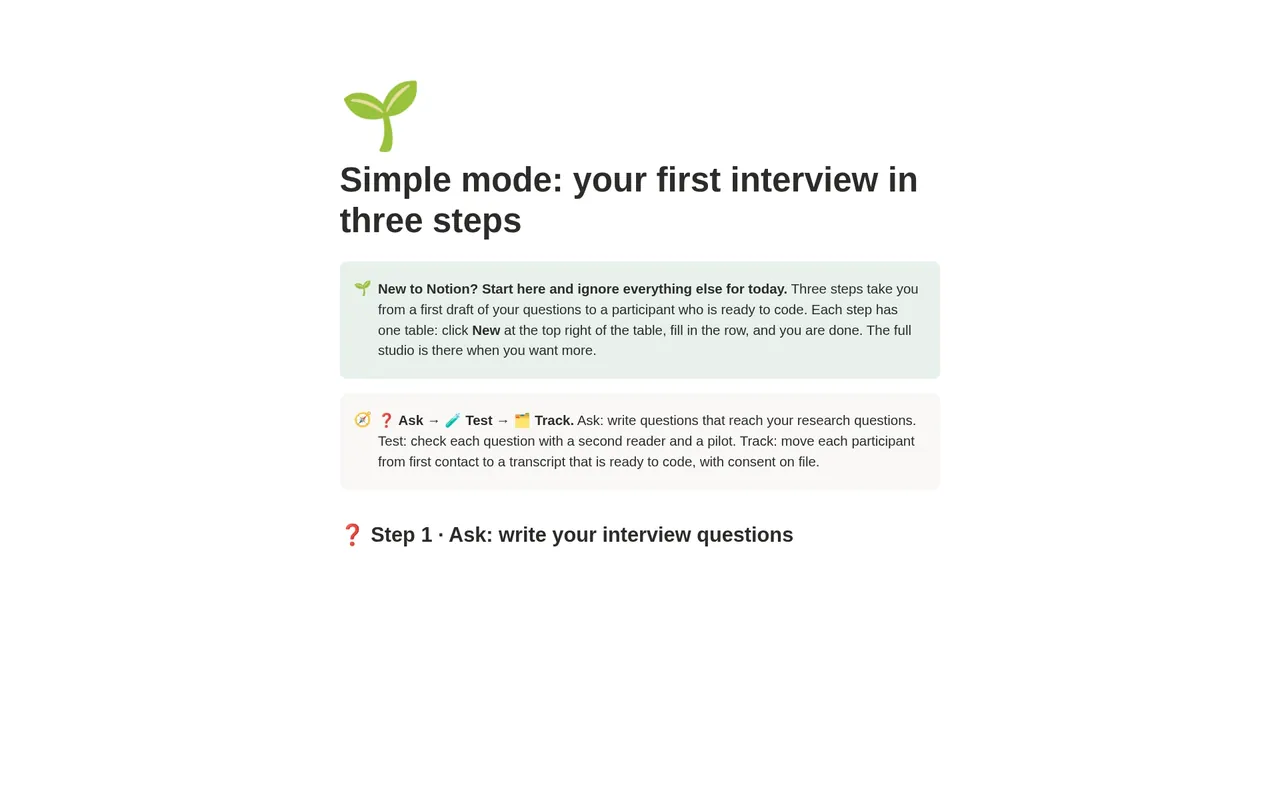
- Simple mode
- Works on Notion's Free plan
- Worked example
Free
Free on Gumroad: enter your email and get a one-page PDF with your link to duplicate the studio. On the Notion Marketplace soon.
See inside the Interview Guide & Fieldwork Studio
The problem it solves
Most interview guides are written once, in a document, and never checked against the research questions they are meant to answer. Then the supervisor's comments arrive: "this question is leading", "this one asks two things at once", "which of these answers RQ2?"
The pilot makes it harder. You change the guide after the practice interview, which is what a pilot is for (Kallio et al., 2016). Six months later, writing your methods chapter, you cannot remember what changed or why.
Then there is fieldwork. Who has consented? Which transcripts have you checked against the audio, and which are anonymised? For most students it lives in their head and an email thread. This studio keeps it in one place, and flags consent, anonymisation and withdrawal problems before you use the data.
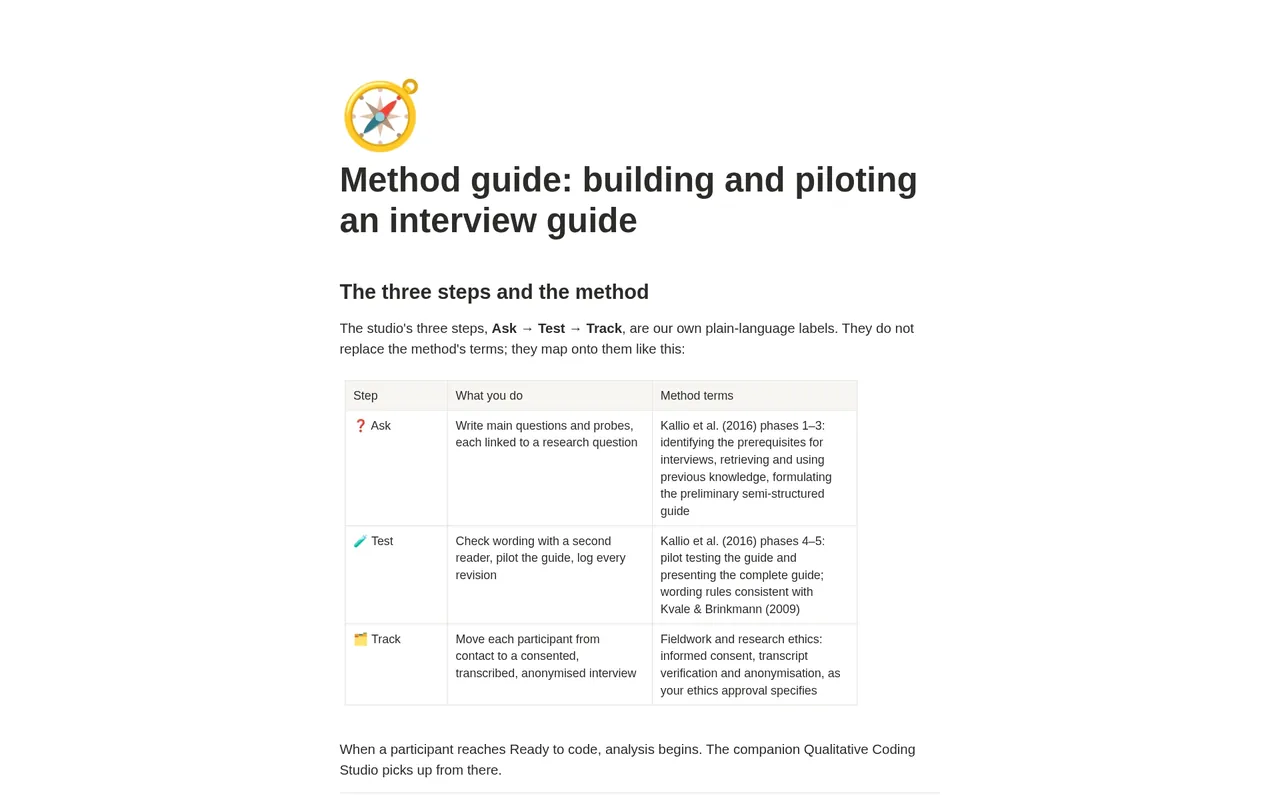
How it works: Ask → Test → Track
Ask
Write main questions and follow-up probes, and link each one to the research question it serves. A coverage check shows any research question your guide does not yet reach.
Test
Tick a four-point wording checklist with a peer or supervisor: open, single issue, neutral, plain language. After the pilot, retire questions as Replaced or Dropped, with the decision that changed them.
Track
Move each participant across a board from Contacted to Ready to code. Each row shows its next step, and an ethics flag if something is missing.
What the studio checks for you
Each question, each research question and each participant carries a plain-language status, worked out by formulas from what you have entered and ticked. These are the main labels.
Question check, per interview question
- ⚪ Not reviewed yet: tick the four wording checks: active, but nobody has checked the wording.
- 🔴 Leading: rewrite: the reviewer left Neutral unticked.
- 🟡 Revise wording: neutral, but another check failed, for example a closed question.
- 🟠 Add probes / 🟠 Link the probe to its RQ: a main question with no active probe, or a probe not linked to its research question. Similar prompts cover other missing links.
- ✅ Ready: all four checks pass and every link is in place. Retired questions read ⚪ Not in use.
Coverage, per research question
- ⚪ No questions yet: link a main question: nothing is linked yet.
- 🔴 Uncovered: no active main question: only retired questions or probes reach it.
- 🟠 No probes: add a follow-up probe: a main question reaches it, but no probe does.
- 🟡 Check wording: covered, but a linked question still needs revising.
- ✅ Covered: main questions and probes, all with wording that passes.
Ethics flag, per participant
- 🔴 No consent on file: at Consented or later, with no consent recorded.
- 🔴 Not anonymised / 🟠 Transcript not checked: the stage has moved on before the data work was done.
- 🔴 Withdrawn: remove data: a withdrawn participant whose data is still there.
- ✅ OK: nothing missing for the stage reached. A row with no stage reads ⚪ Set a stage.
The wording checks are a reviewer's judgement. The formula only adds up what was ticked; it cannot read a question. A 🔴 means "decide and justify", not "forbidden".
The worked example
Fictional study
The studio opens with a fictional example: the Newly Diagnosed study of young adults recently diagnosed with type 1 diabetes, with the same participants as the Qualitative Coding Studio. It has 2 research questions, 18 interview questions (15 active, 3 retired after the pilot), 10 participants and 4 decisions. Two problems are planted. One probe, "Do you feel more independent now?", is closed, so it reads 🟡 Revise wording and RQ1 reads 🟡 Check wording. The pilot interview reads 🔴 No consent on file, because the protocol needs a signed form that is not yet filed. Clearing the example takes about two minutes.
Method and sources
The studio follows the five phases for developing a semi-structured interview guide from Kallio, Pietilä, Johnson & Kangasniemi (2016), in GradSummit's own words. The four wording checks are general good practice, consistent with Kvale & Brinkmann (2009) and McGrath, Palmgren & Liljedahl (2019).
A fieldwork and ethics checklist covers consent in the form your ethics approval specifies (written, electronic or recorded), transcript checks, pseudonyms with the key kept apart, and withdrawal.
What the studio does not do
- It does not detect leading or closed questions by itself. The checks reflect what you and your reviewer tick.
- It does not replace your ethics approval or your institution's data-protection rules, and it is not legal or ethics advice.
- It does not record or store interviews. Keep audio and identifiable transcripts out of any workspace you share; use pseudonyms.
- It does not analyse your data. Notion cannot move a row between databases, so you copy a participant who is Ready to code into your coding workspace yourself.
What you get
- A one-page PDF with your link, sent by Gumroad when you click Get it free and enter your email. Click it, then Duplicate, and the studio is in your own Notion workspace, yours to keep.
- Simple mode: three steps, one small table each, with a plain instruction above every table. You can start in Notion for the first time today.
- A research question coverage table, your active guide in running order, questions to fix, a guide history, a fieldwork board with ethics flags, and a decision log.
- Export views that turn your interview guide, participant log and decision log into clean CSV tables for an appendix.
- A Start here page, a method guide with full references, and a worked fictional example you can clear in a few minutes.
- Works on Notion's Free plan. No charts, no paid features and no Notion AI needed.
Questions
Will it tell me whether a question is leading?
Not on its own. A second reader ticks four checks for each question, and the studio turns those ticks into a plain instruction and rolls them up to each research question.
Does it work with the Qualitative Coding Studio?
Yes. The participant fields match its Sources database, so when a participant is Ready to code you copy the row across and analysis picks up where fieldwork ends.
Will I get updates?
The link in your PDF points to the published studio, so if it is updated you can duplicate the current version again. Your own copy never changes underneath you, which matters halfway through your fieldwork.
Should I analyse my pilot interview?
Usually not, because the guide often changes afterwards. Some designs include it if the guide barely changed and consent covers it. Either way, log the decision and justify it.
Does it work on Notion's Free plan?
Yes. The studio uses ordinary databases, relations, rollups and formulas. It needs no charts, no paid Notion features and no Notion AI, so the Free plan is enough.
Is it really free? How do I get it?
Yes. Click Get it free and Gumroad asks for your email address; the price is $0. You then get a one-page PDF with the link. Open the link, click Duplicate, and the studio is copied into your own Notion workspace. It is yours to keep. It is also with Notion for review and will appear on the Notion Marketplace soon.
What if the link does not work or something is wrong?
Email rafiq@gradsummit.com and we will fix it.
Related guides and templates
Other research studios
Interview Guide & Fieldwork Studio
Ask → Test → Track, with a worked example and a method guide. Free.
Interview Guide & Fieldwork Studio by Rafiq Muhammad, MD, MIHMEP, PhD (GradSummit). The example study and all its data are fictional and created for teaching.
Notion is a trademark of Notion Labs, Inc. GradSummit is not affiliated with or endorsed by Notion.