An ethics application tracker for Notion that checks every version you use
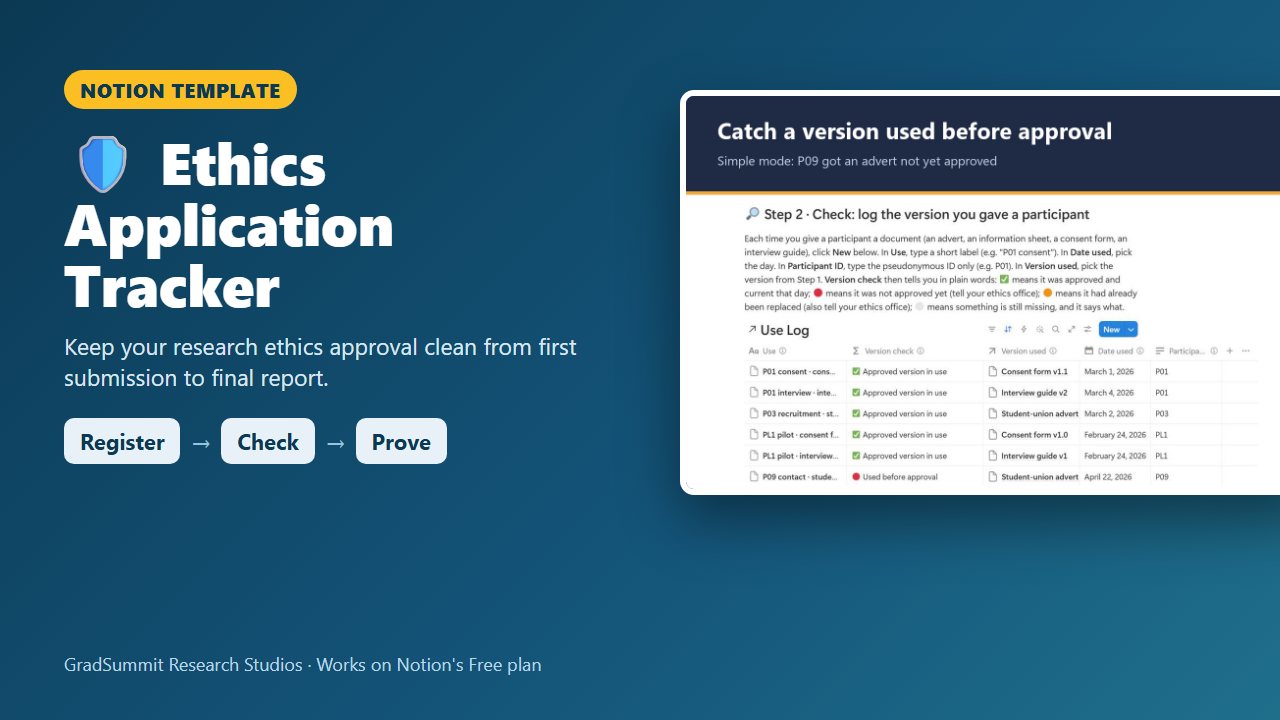
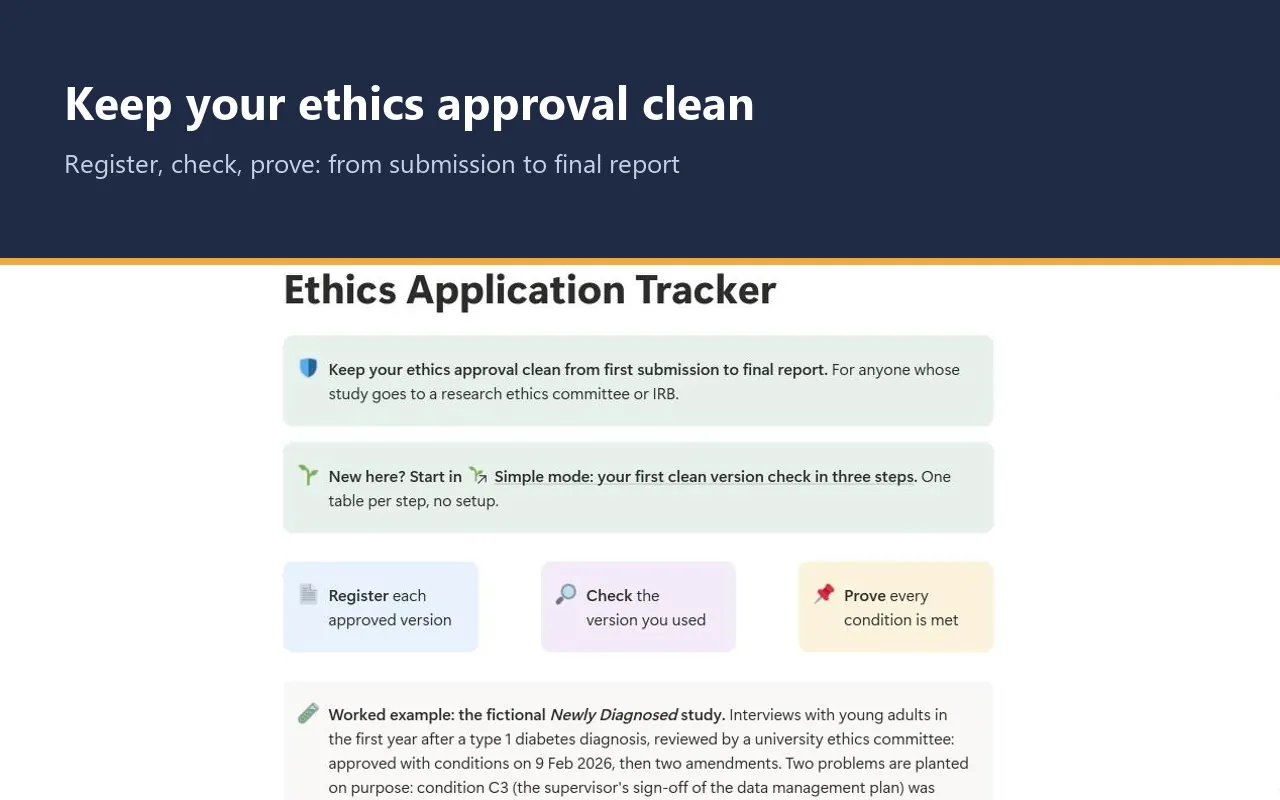
Register the document versions your committee approved, log each time you give a participant a document, and see straight away if a version was used before approval or after it was replaced.
For master's and doctoral researchers whose study goes to a university research ethics committee, an NHS research ethics committee or a US IRB, from first submission to the final report.
- Register → Check → Prove
- Simple mode
- Works on Notion's Free plan
- Worked example
$12
One-time price. Checkout on Gumroad; an instant PDF with your link to duplicate the studio.
See inside the Ethics Application Tracker
The problem it solves
Getting ethics approval feels like the finish line. It is the start of a record you have to keep. "Which consent form is the approved one?" "Did that new advert need an amendment first?" "Did I meet the condition in the last paragraph of the approval letter?"
Once fieldwork starts, versions multiply. The consent form goes to v1.1 after an amendment, the interview guide to v2, and a new recruitment advert waits for approval. Hand a participant the old form the day after the new one is approved, or the new advert a week before it is, and you have a deviation to report, whether you noticed or not.
Conditions of approval are the other quiet risk. An approval with conditions is still an approval with work attached, and a committee or monitor can ask you to show the evidence for each one.
This tracker keeps the record as you go, and checks each use against the dates you entered.
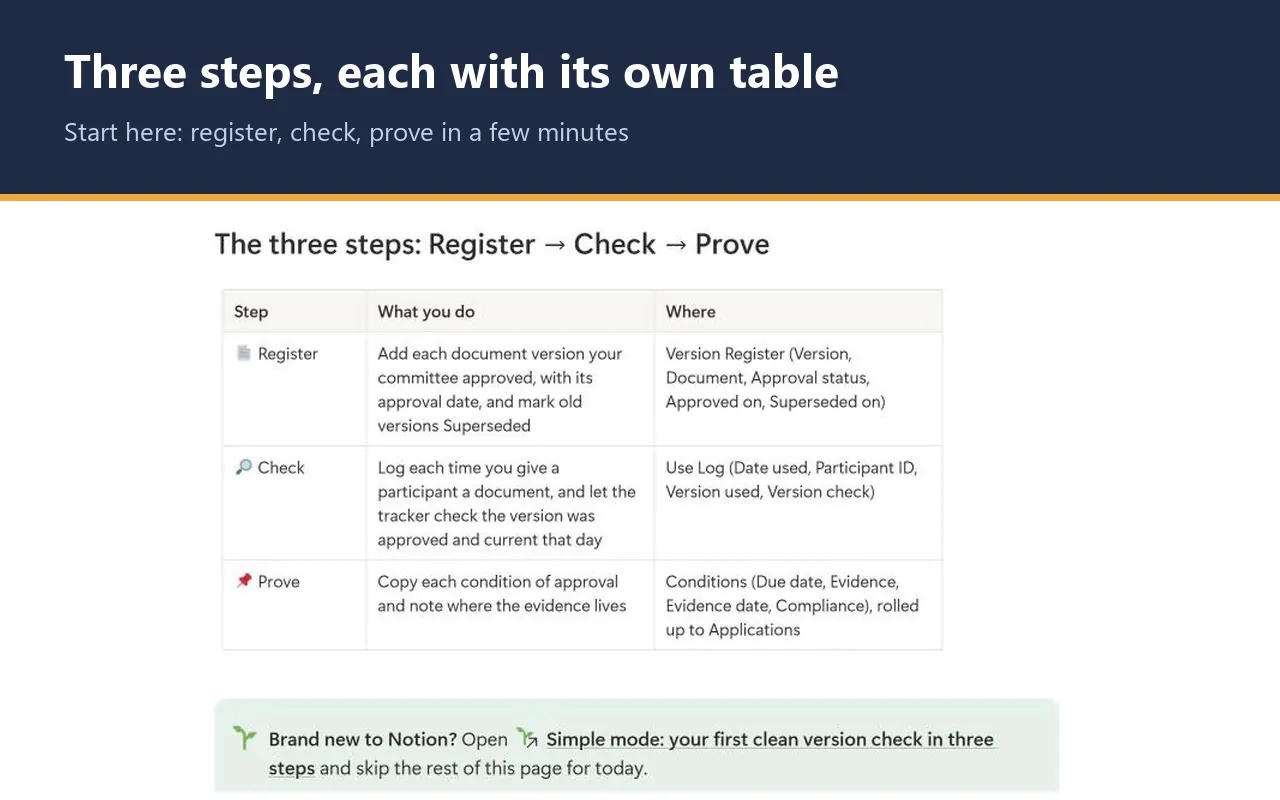
How it works: Register → Check → Prove
Register
Add each document version your committee approved, with its approval date. When a new version is approved, mark the old one Superseded with the date.
Check
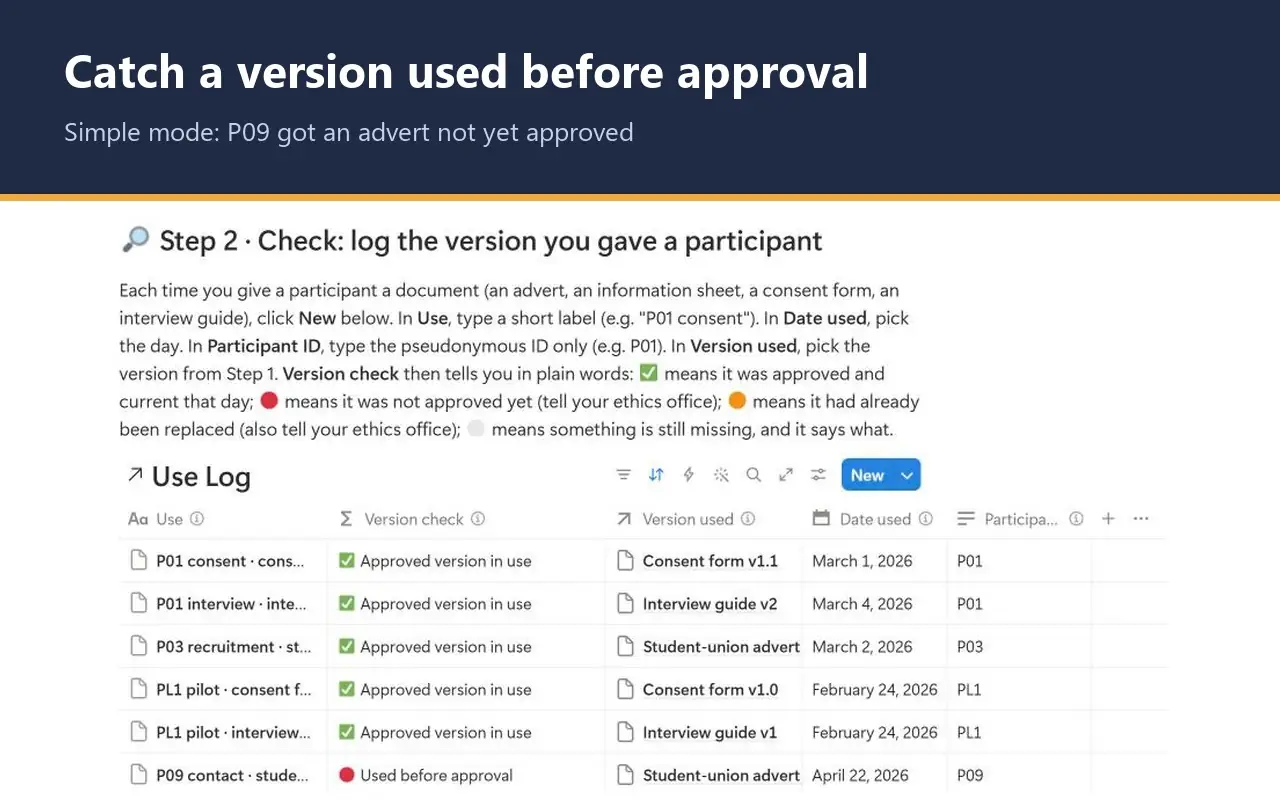
Each time you give a participant a document, log it with the date and a pseudonymous ID such as P01. The tracker compares the date with the version's approval and supersession dates.
Prove
Copy each condition of approval, give it a due type or date, and note where the evidence lives: an email, a signed form, a dated file.
What the studio checks for you
Each use, each version, each condition and each submission carries a plain-language status, worked out by formulas from the dates you enter. These are the main labels.
Version check, per use
- ✅ Approved version in use: approved on or before the day you used it, and not yet replaced.
- 🔴 Used before approval: the version was used before its approval date.
- 🔴 Not an approved version: the version has no approval on record.
- 🟠 Used after it was superseded: a newer version had already replaced it that day.
- ⚪ Link the version you used: or a date, or a single version, is still missing; it says which.
Compliance, per condition of approval
- ✅ Evidence logged: evidence and its date are recorded.
- 🟡 Open: due in N days: not yet met, and not yet due.
- 🔴 Overdue: no evidence logged: past its due date with no evidence.
- 🟡 Ongoing: evidence over 12 months old: an ongoing condition whose evidence needs refreshing.
- 🟠 Say where the evidence lives, not a placeholder: the evidence field holds tbc, n/a or similar.
Status check, per submission
- 🔴 Approval expired / 🔴 Report overdue: the most urgent dates come first.
- 🟠 N queries open: committee queries still waiting for your response or their acceptance.
- 🟡 Report due in N days: a progress report falls due within 90 days.
- ✅ Approved: approved, with nothing open.
The 90-day report window, the 12-month window for ongoing evidence and every colour cut-off are GradSummit conventions, labelled as such in the tracker. Same-day rules are stated: a version used on its approval day counts as approved, and the old version counts as superseded that day.
The worked example
Fictional study
The worked example is fictional: the Newly Diagnosed study, interviews with young adults in the first year after a type 1 diabetes diagnosis, reviewed by a university ethics committee. It was approved with conditions on 9 Feb 2026, then two amendments followed. It has 3 submissions, 5 committee queries, 5 conditions, 10 document versions, 6 logged uses and 8 data management items. Two problems are planted for you to find: participant P09 was contacted with a student-union advert two weeks before it was approved (🔴 Used before approval, with a note that it was reported), and the supervisor's sign-off of the data management plan is overdue (🔴 Overdue: no evidence logged). Clearing the example takes a few minutes.
Method and sources
The tracker follows the UK Policy Framework for Health and Social Care Research (Health Research Authority, 2017), the ESRC Framework for Research Ethics (2015), the revised US Common Rule, 45 CFR 46 (HHS, 2017), and the Belmont Report (1979). It paraphrases them; it does not reproduce them.
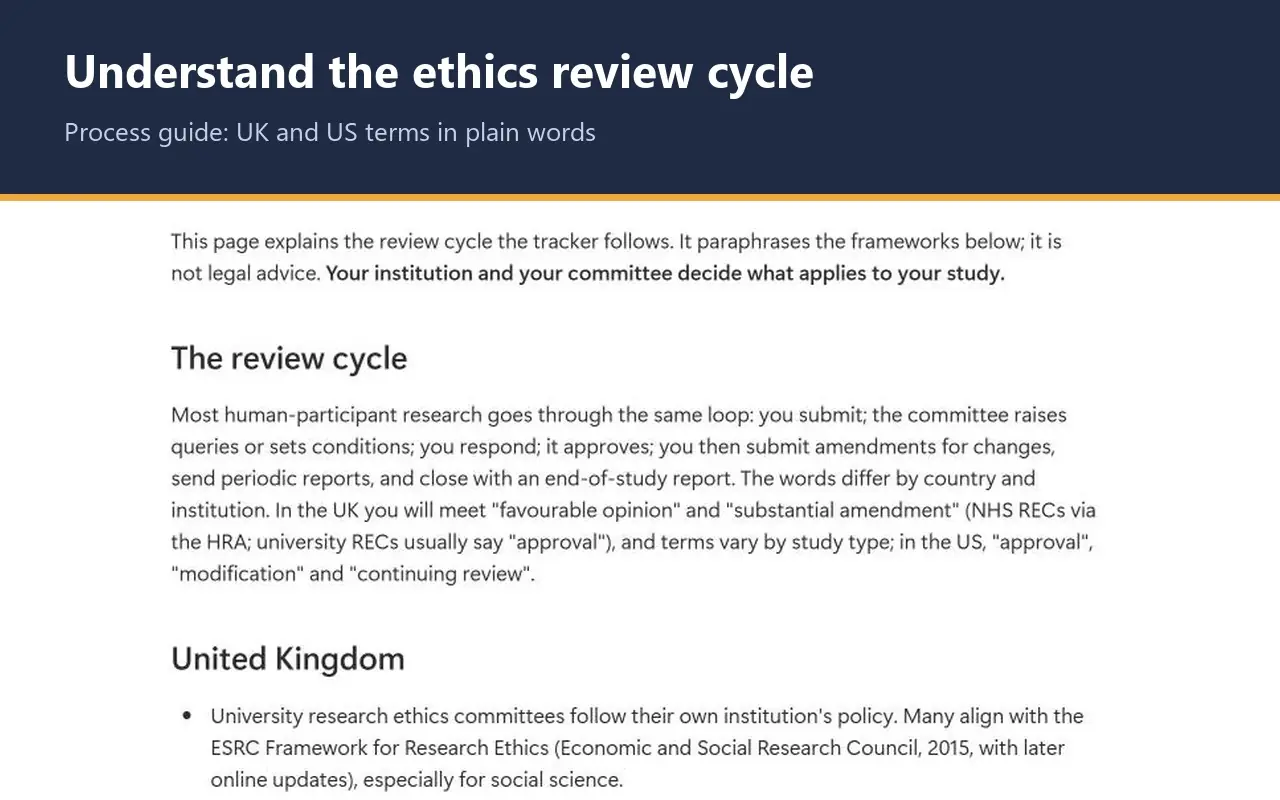
An ethics process guide sets out the review cycle in plain words: submit, answer queries, meet conditions, amend, report and close. It covers UK university committees, NHS committees through the HRA and US IRBs, including when continuing review is and is not required under the revised rule.
What the studio does not do
- It keeps records; it does not give legal advice or grant approval. Your institution and your committee decide what applies.
- It does not decide whether a change counts as an amendment. Ask your ethics office.
- The checks are only as good as the dates you enter, and they look at each version on its own, so mark old versions Superseded.
- Never store participant names or contact details in it. Use pseudonymous IDs only.
What you get
- A one-page PDF with your private link, sent by Gumroad straight after checkout. Click it, then Duplicate, and the studio is in your own Notion workspace, yours to keep.
- Simple mode: three steps, one small table each, with a plain instruction above every table. You can start in Notion for the first time today.
- Where your approval stands, committee queries, conditions of approval, a version register, a use log, an amendment log and a data management checklist, all linked.
- Export views that turn your use log, version register and conditions into clean CSV tables for reports.
- A Start here page, a method guide with full references, and a worked fictional example you can clear in a few minutes.
- Works on Notion's Free plan. No charts, no paid features and no Notion AI needed.
Questions
Does it work for NHS ethics and US IRBs as well as university committees?
Yes. The databases fit any committee that approves document versions and sets conditions. The process guide covers UK university committees, NHS committees through the HRA and US IRBs, with the terms each uses, such as favourable opinion, substantial amendment, modification and continuing review.
What should I do if it flags a 🔴?
Tell your ethics office promptly. What counts as a deviation, and how to report it, is set by your institution. The tracker only shows you the record; it does not report anything for you.
Will I get updates?
The link in your PDF points to the published studio, so if it is updated you can duplicate the current version again. Your own copy never changes underneath you, which matters halfway through your fieldwork.
Does it work on Notion's Free plan?
Yes. The studio uses ordinary databases, relations, rollups and formulas. It needs no charts, no paid Notion features and no Notion AI, so the Free plan is enough.
How do I get the studio after I pay?
Checkout is on Gumroad. Straight after you pay $12, you get a one-page PDF with your private link. Open the link, click Duplicate, and the studio is copied into your own Notion workspace. It is yours to keep.
What if the link does not work or something is wrong?
Digital products cannot be returned once delivered, but if the link does not work or something is wrong with the studio, email rafiq@gradsummit.com and we will fix it or refund you.
Can my research group or class use it?
Each purchase is for one person. For a class or research group, email rafiq@gradsummit.com about a group licence.
Related guides and templates
Other research studios
Ethics Application Tracker
Register → Check → Prove, with a worked example and a method guide. $12, one-time.
Ethics Application Tracker by Rafiq Muhammad, MD, MIHMEP, PhD (GradSummit). The example study and all its data are fictional and created for teaching.
Notion is a trademark of Notion Labs, Inc. GradSummit is not affiliated with or endorsed by Notion.