An IPA analysis template for Notion, one case at a time
Log experiential statements for one person, gather them into personal experiential themes, finish that case, and only then build group themes, with convergence and divergence written down.
For master's and doctoral researchers using Interpretative Phenomenological Analysis with a small, homogeneous sample, in health psychology, nursing, counselling, education and related fields.
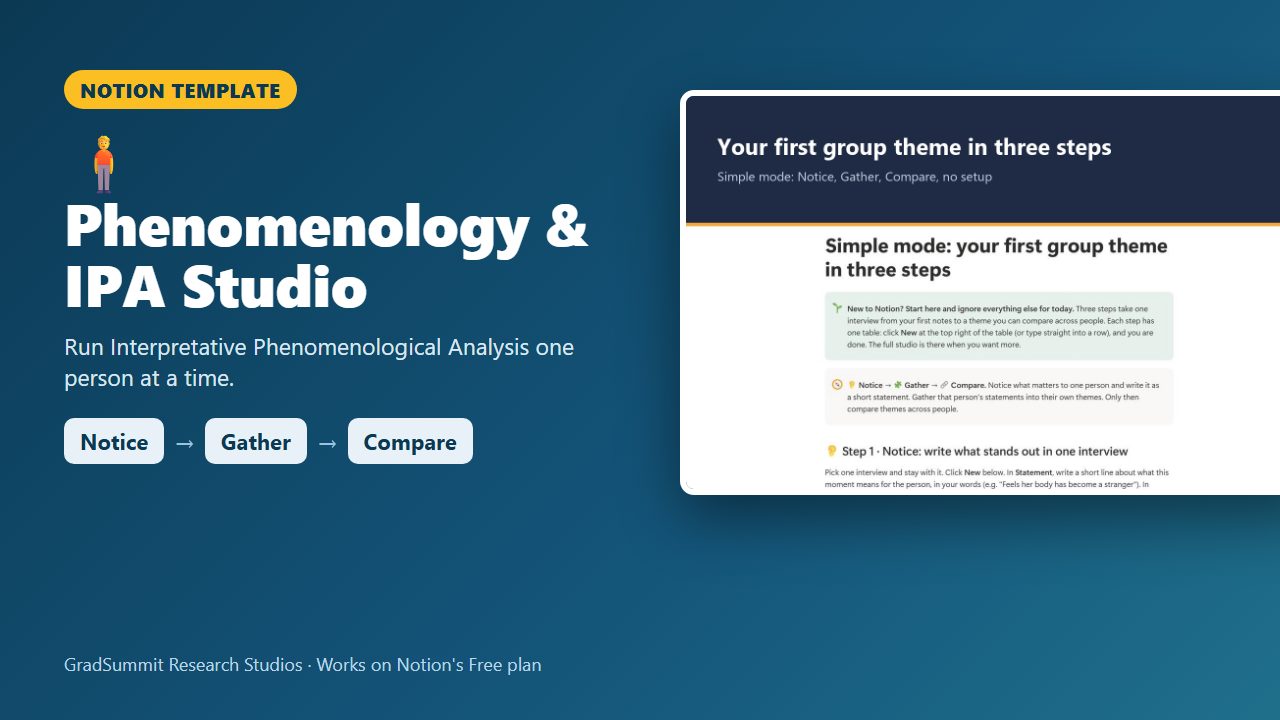
- Notice → Gather → Compare
- Simple mode
- Works on Notion's Free plan
- Worked example
$15
One-time price. Checkout on Gumroad; an instant PDF with your link to duplicate the studio.
See inside the Phenomenology & IPA Studio
The problem it solves
The comment IPA students dread is "this reads like thematic analysis". It usually means the analysis lost its idiographic focus: all the transcripts were coded together and the themes were counted, instead of each person being understood in their own terms before anyone was compared.
IPA asks you to finish one case before you start the next, and to build group themes only from finished cases (Smith, Flowers & Larkin, 2022). That is easy to say and hard to prove. A folder of coded transcripts cannot show the order you worked in.
Then there is divergence. Supervisors want to see how participants differ within a shared theme, not just what they have in common (Nizza, Farr & Smith, 2021). Divergence is the part most often left until the write-up, and then left out.
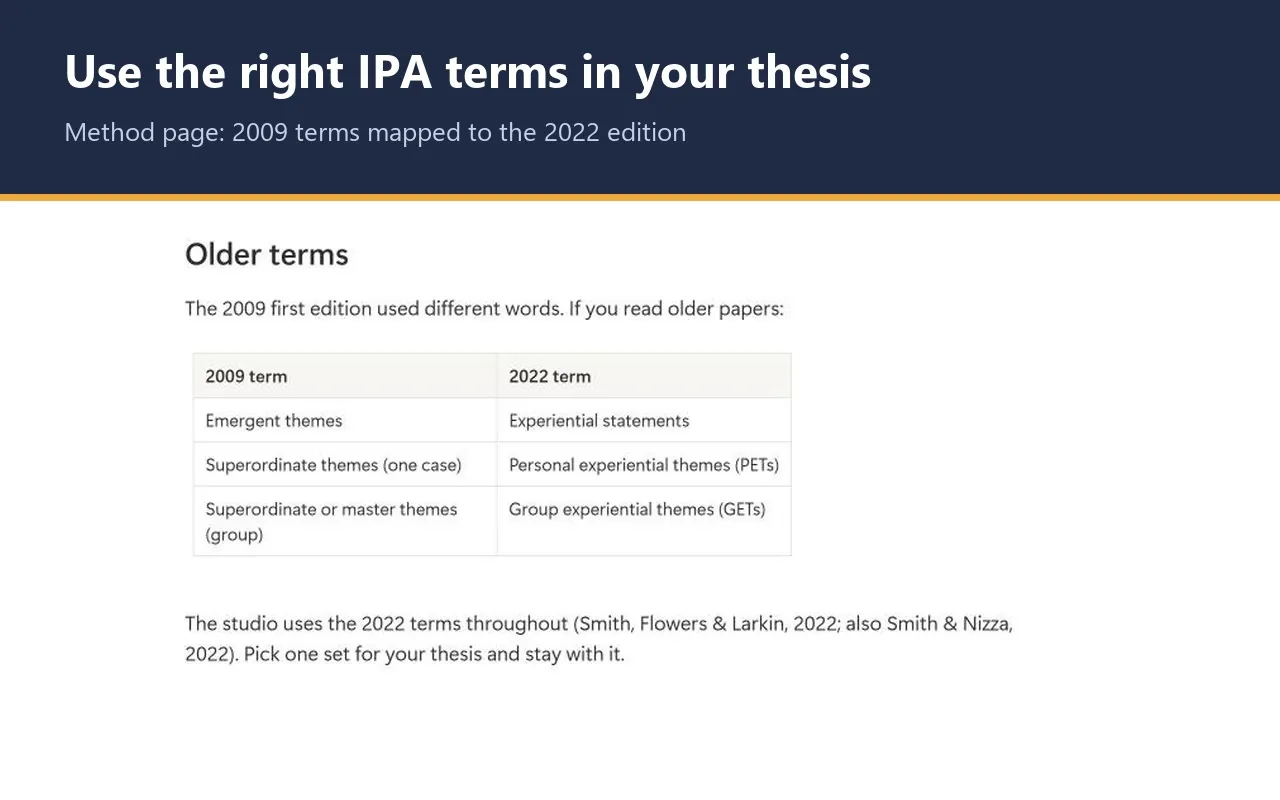
And there is vocabulary. Older papers talk about emergent and superordinate themes; the second edition talks about experiential statements, PETs and GETs. Mixing the two in one methods chapter is a small error that examiners notice. This studio uses the 2022 terms throughout and translates the old ones for you.
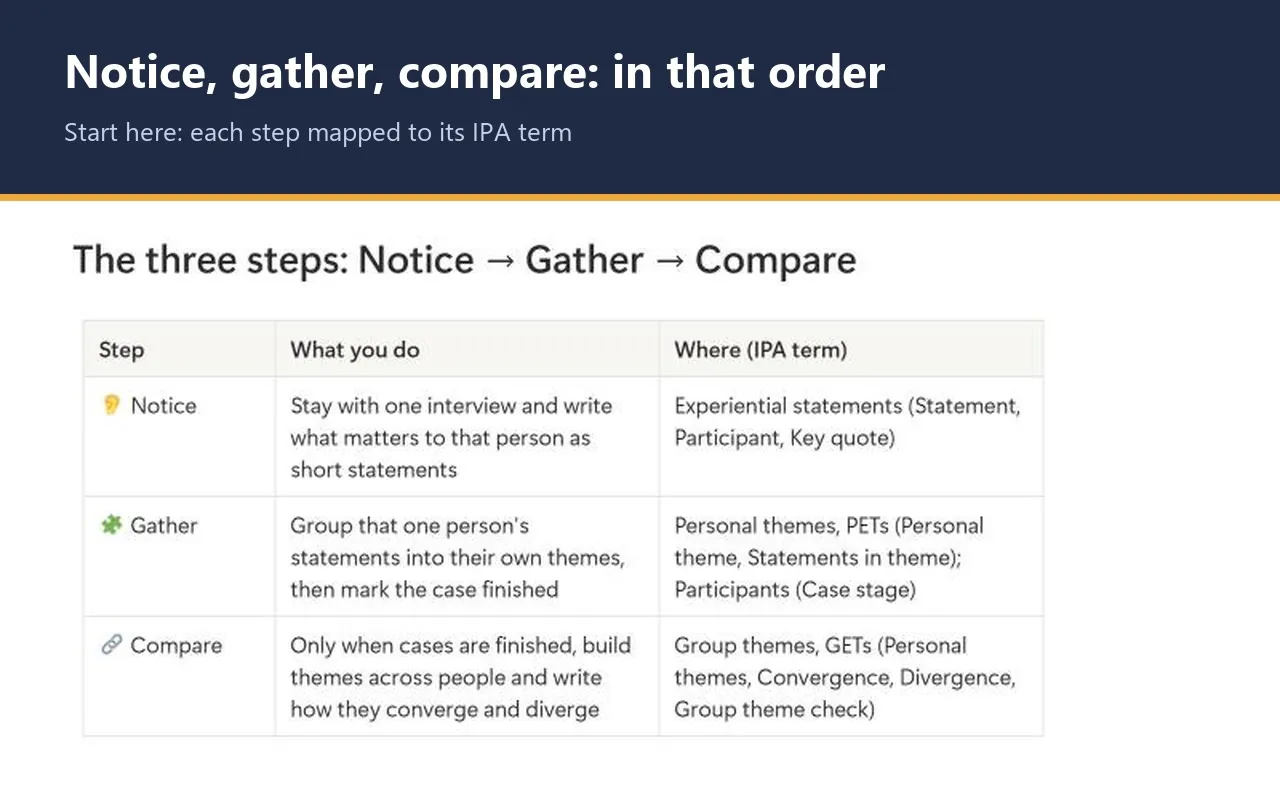
How it works: Notice → Gather → Compare
Notice
Stay with one interview. Log what matters to that person as experiential statements, each with its note type, where it sits in the transcript and a short de-identified quote.
Gather
Cluster that person's statements into personal experiential themes (PETs). Place every statement or set it aside with a reason, then mark the case finished before you move on.
Compare
Once cases are finished, build group experiential themes (GETs) from their PETs, and write both how the cases converge and how they diverge.
What the studio checks for you
Two formulas keep the analysis idiographic: one on each participant and one on each group theme. These are the labels they show.
Case progress, per participant
- ⚪ Not started: no experiential statements yet.
- 🔵 In progress: stay with this case: statements logged, but the case is not marked finished.
- ⚠️ Marked finished but no PETs: the case was marked finished before any personal theme was built.
- 🟠 Statements not yet placed or set aside: marked finished, but some statements are in no PET and not set aside.
- 🟢 Case finished: every statement placed in a PET or set aside.
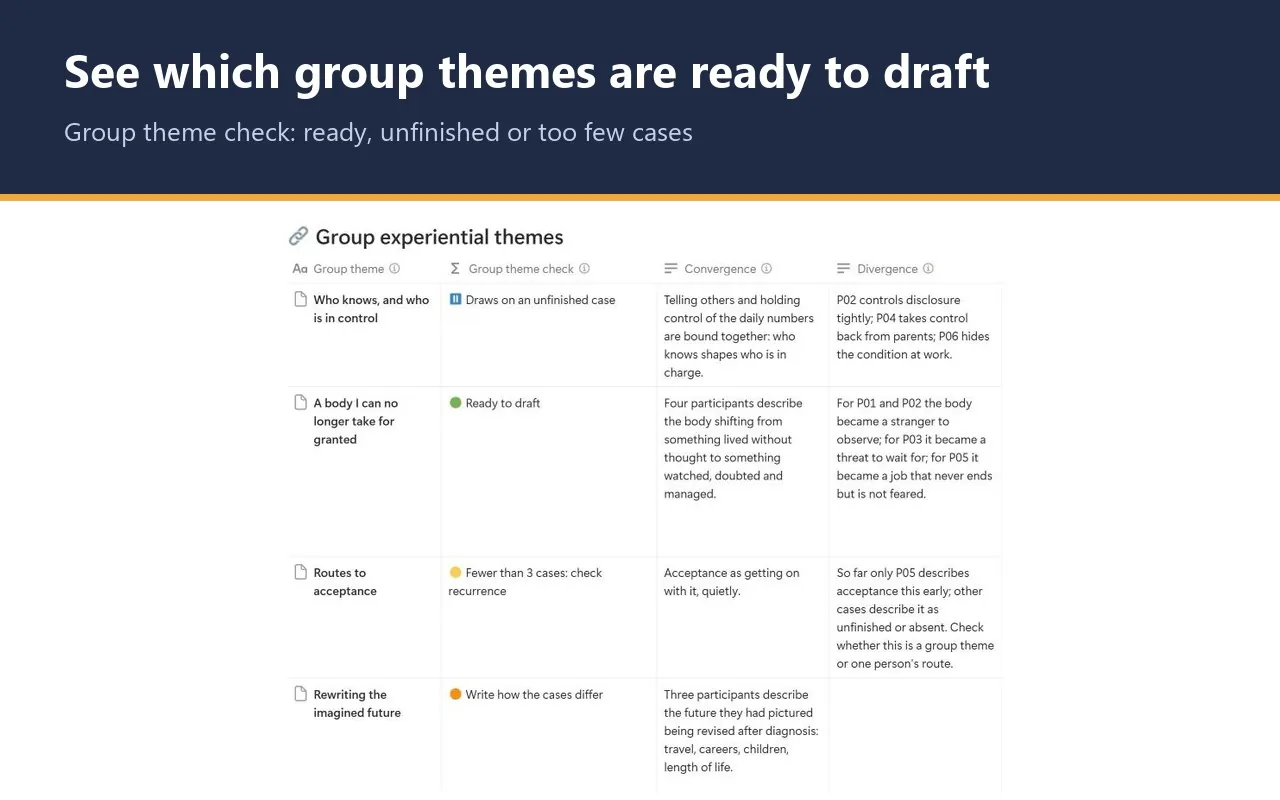
Group theme check, per GET
- ⚪ No PETs linked yet: nothing feeds this group theme.
- 🔗 A linked PET needs exactly one participant: a personal theme is not tied to the person it came from.
- ⏸️ Draws on an unfinished case: at least one PET comes from a case you have not finished.
- 🟡 Fewer than 3 cases: check recurrence: the theme rests on fewer than three participants.
- 🟠 Write what the cases share / Write how the cases differ: convergence or divergence is not written yet.
- 🟢 Ready to draft: finished cases only, three or more of them, with convergence and divergence written.
The three-case prompt is informed by Smith (2011) and labelled as a GradSummit convention. It asks you to check recurrence; a theme found in fewer cases can still be reported with a rationale.
The worked example
Fictional study
The worked example is fictional: six young adults (P01 to P06) diagnosed with type 1 diabetes in the last year, asked about the lived experience of diagnosis. It has 18 experiential statements, 11 PETs, 4 GETs and 6 reflexive journal entries. Five cases are finished and one is still in progress, so one group theme shows ⏸️ until that case is done. Another shows 🟡 because it rests on a single case, and one shows 🟠 because its divergence is not written. One statement is set aside with a real reason, to show that setting aside is a legitimate IPA choice. Clearing the example takes a few minutes.
Method and sources
The studio follows Smith, Flowers & Larkin (2022) and Smith & Nizza (2022) for the steps and the 2022 terms, Smith (2011) for the recurrence prompt, Nizza, Farr & Smith (2021) for the four markers of high-quality IPA, and Larkin, Watts & Clifton (2006).
The reflexive journal is deliberately not called a bracketing journal. In IPA, fore-understanding is examined and used within the hermeneutic circle rather than set aside. A separate page sets IPA beside descriptive (Giorgi; Colaizzi) and hermeneutic (van Manen) phenomenology for orientation, and another compares IPA with thematic analysis and grounded theory.
What the studio does not do
- It does not judge the quality of your interpretation. The checks look at structure and sequence, not meaning.
- It implements IPA only. If you follow Giorgi, Colaizzi or van Manen, use that method's own steps and terms.
- It does not produce an "essence": IPA does not seek one.
- Use short, de-identified quotes only. Do not paste full transcripts into a workspace you share.
What you get
- A one-page PDF with your private link, sent by Gumroad straight after checkout. Click it, then Duplicate, and the studio is in your own Notion workspace, yours to keep.
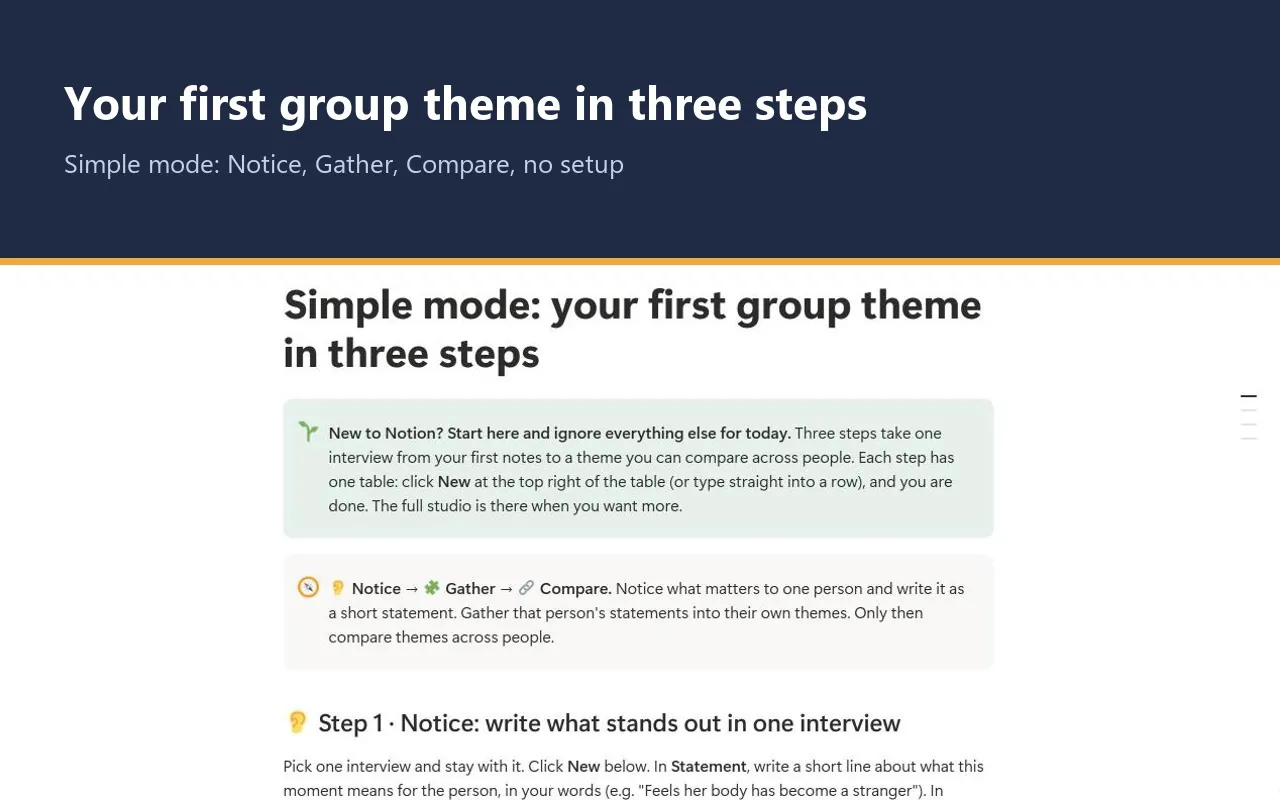
- Simple mode: three steps, one small table each, with a plain instruction above every table. You can start in Notion for the first time today.
- One case at a time, statements case by case, PETs by case, group themes with their checks, and a reflexive journal for before, during and after each interview.
- Export views that turn your statements, themes and journal into clean CSV tables for an appendix.
- A Start here page, a method guide with full references, and a worked fictional example you can clear in a few minutes.
- Works on Notion's Free plan. No charts, no paid features and no Notion AI needed.
Questions
Does it use the 2009 or the 2022 IPA terms?
The 2022 terms: experiential statements, personal experiential themes (PETs) and group experiential themes (GETs). The method page has a translation table from the 2009 terms (emergent themes, superordinate themes, master themes), so you can read older papers and still write consistently.
Can I use it for descriptive or hermeneutic phenomenology?
Not as designed. The databases follow IPA's sequence from case to group. A page sets out how Giorgi, Colaizzi and van Manen differ, for orientation, but if you follow one of them, use its own steps and terms rather than mixing them with IPA's.
Will I get updates?
The link in your PDF points to the published studio, so if it is updated you can duplicate the current version again. Your own copy never changes underneath you, which matters halfway through an analysis.
Does it work on Notion's Free plan?
Yes. The studio uses ordinary databases, relations, rollups and formulas. It needs no charts, no paid Notion features and no Notion AI, so the Free plan is enough.
How do I get the studio after I pay?
Checkout is on Gumroad. Straight after you pay $15, you get a one-page PDF with your private link. Open the link, click Duplicate, and the studio is copied into your own Notion workspace. It is yours to keep.
What if the link does not work or something is wrong?
Digital products cannot be returned once delivered, but if the link does not work or something is wrong with the studio, email rafiq@gradsummit.com and we will fix it or refund you.
Can my research group or class use it?
Each purchase is for one person. For a class or research group, email rafiq@gradsummit.com about a group licence.
Related guides and templates
Other research studios
Phenomenology & IPA Studio
Notice → Gather → Compare, with a worked example and a method guide. $15, one-time.
Phenomenology & IPA Studio by Rafiq Muhammad, MD, MIHMEP, PhD (GradSummit). The example study and all its data are fictional and created for teaching.
Notion is a trademark of Notion Labs, Inc. GradSummit is not affiliated with or endorsed by Notion.