A grounded theory template for Notion that shows your saturation
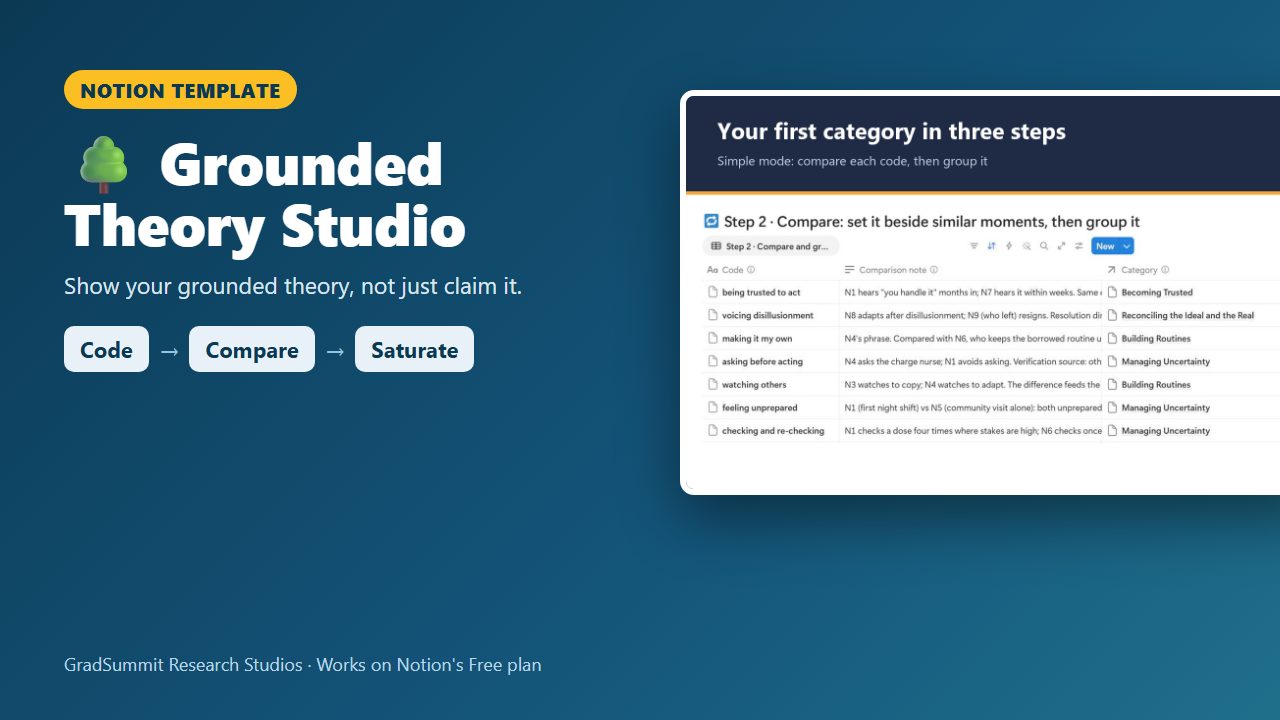
Code your interviews, compare and group them into categories, and judge saturation the way the method does: category by category, through each category's properties, not by counting interviews.
For master's and doctoral researchers building a grounded theory from interviews, from the first few transcripts to the core category.
- Code → Compare → Saturate
- Simple mode
- Works on Notion's Free plan
- Worked example
$15
One-time price. Checkout on Gumroad; an instant PDF with your link to duplicate the studio.
See inside the Grounded Theory Studio
The problem it solves
Grounded theory is easy to claim and hard to show. The questions that catch students out at upgrade or viva are rarely about coding itself. They are "saturation of what?", "why did you interview that person next?" and "why is this your core category?"
Most students answer the first one with a number: saturation was reached at interview 12. But in grounded theory, saturation means that new data stops adding new properties to a category (Glaser & Strauss, 1967; Charmaz, 2014). One category can be saturated while another is still thin. A count of interviews cannot show that, and an examiner knows it.
The second question is about theoretical sampling. After your first purposive interviews, each new case should be chosen to fill a gap in a category. If your log only says who agreed to take part, your study starts to look like thematic analysis with a grounded theory label.
The trouble is that this evidence is hard to rebuild afterwards. This studio has you record it as you go: who you sampled and why, what each case added, and when each category stopped growing.
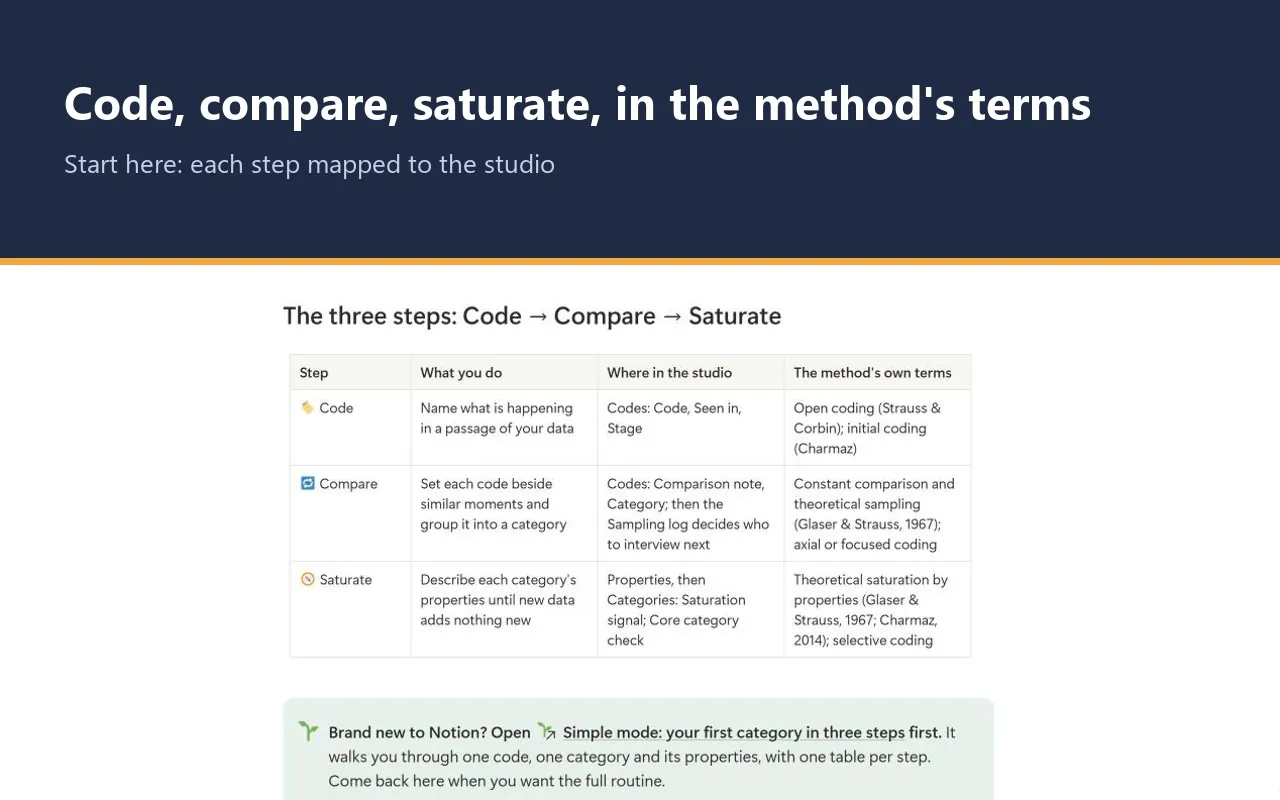
How it works: Code → Compare → Saturate
Code
Read a passage of one interview and name what is happening, ideally with an -ing word close to the participant's own words, such as "checking and re-checking". Each code is linked to the participant whose data shows it.
Compare
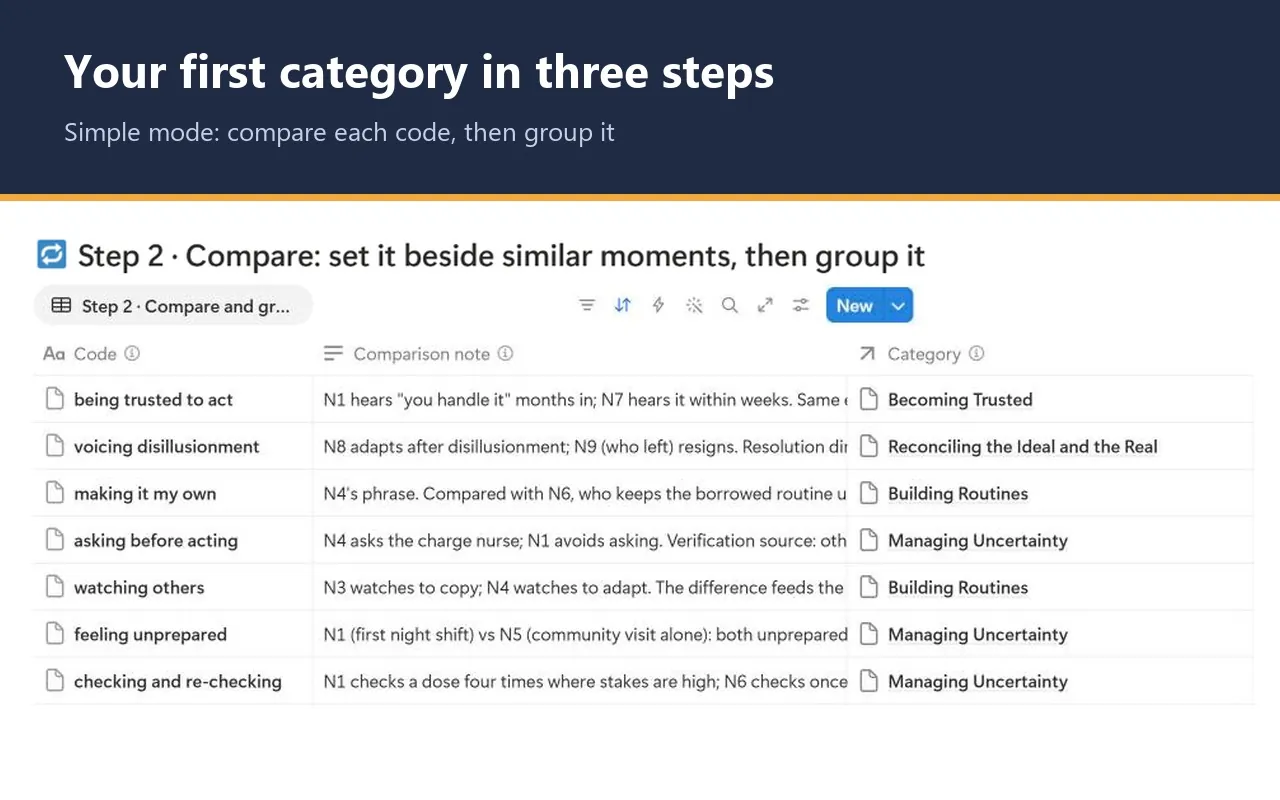
Set each code beside similar moments, in the same interview or another one, and write a short comparison note: what is the same and what differs. That note is your constant comparison, on the record. Then group the code under a category.
Saturate
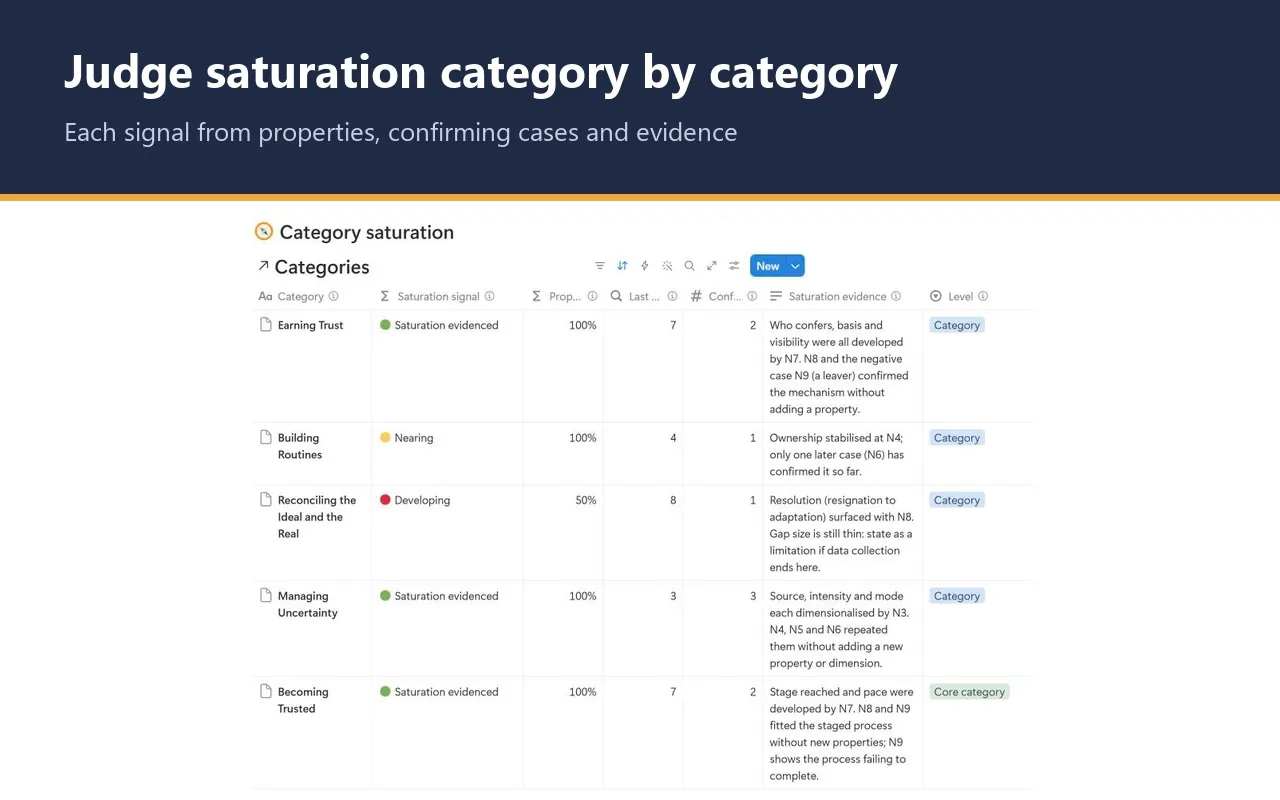
Describe each category's properties and the range each one varies along, with the case where it first surfaced. Tick a property once its whole range is grounded in data, then watch the category's saturation signal move.
What the studio checks for you
Each category, each participant and each core category candidate carries a plain-language status, worked out by formulas from what you have entered. These are the labels you will see.
Saturation signal, per category
- ⚪ Add properties: the category has no properties yet.
- 🔴 Developing: at least one property is not yet dimensionalised.
- 🟡 Nearing: every property is developed, but fewer than two later cases have confirmed them.
- 🟠 Add evidence before claiming: the numbers look saturated, but you have not written the saturation evidence. You cannot reach green without it.
- 🟢 Saturation evidenced: every property developed, at least two confirming cases, and the evidence written.
Sampling justified, per participant
- ➖ Entry sample: part of your initial purposive sample, so no gap is needed.
- ⚠️ Name the category gap: a theoretical or negative case that does not yet name the category it was chosen to develop and the question it answers.
- ✅ Justified by a category gap: the case names both.
Core candidate, per category
- ⭐ Strong candidate: meets all four core category checks, adapted from Strauss & Corbin (1998), and its saturation is evidenced.
- 🔶 Possible: compare with others: meets three or four checks but is not yet a strong candidate.
- – Not the core: meets fewer than three.
You count confirming cases by hand: the cases that informed a category after its last new property and added nothing new. The two-case threshold is a GradSummit teaching convention, not a rule from the literature, and the studio says so.
The worked example
Fictional study
The studio opens with a fully worked, fictional example: the Threshold study, a grounded theory of how newly qualified nurses develop professional confidence in their first year, worked in Strauss & Corbin form. It has 10 participants, 5 categories, 12 properties, 10 codes and 8 memos. Three categories show 🟢, one 🟡 and one 🔴, so you can see every signal working. The sampling log shows a real grounded theory point: theoretical sampling reopens properties that the entry sample had stopped producing. The most connected category, Earning Trust, scores 🔶; the core, Becoming Trusted, scores ⭐. Clearing the example takes a few minutes.
Method and sources
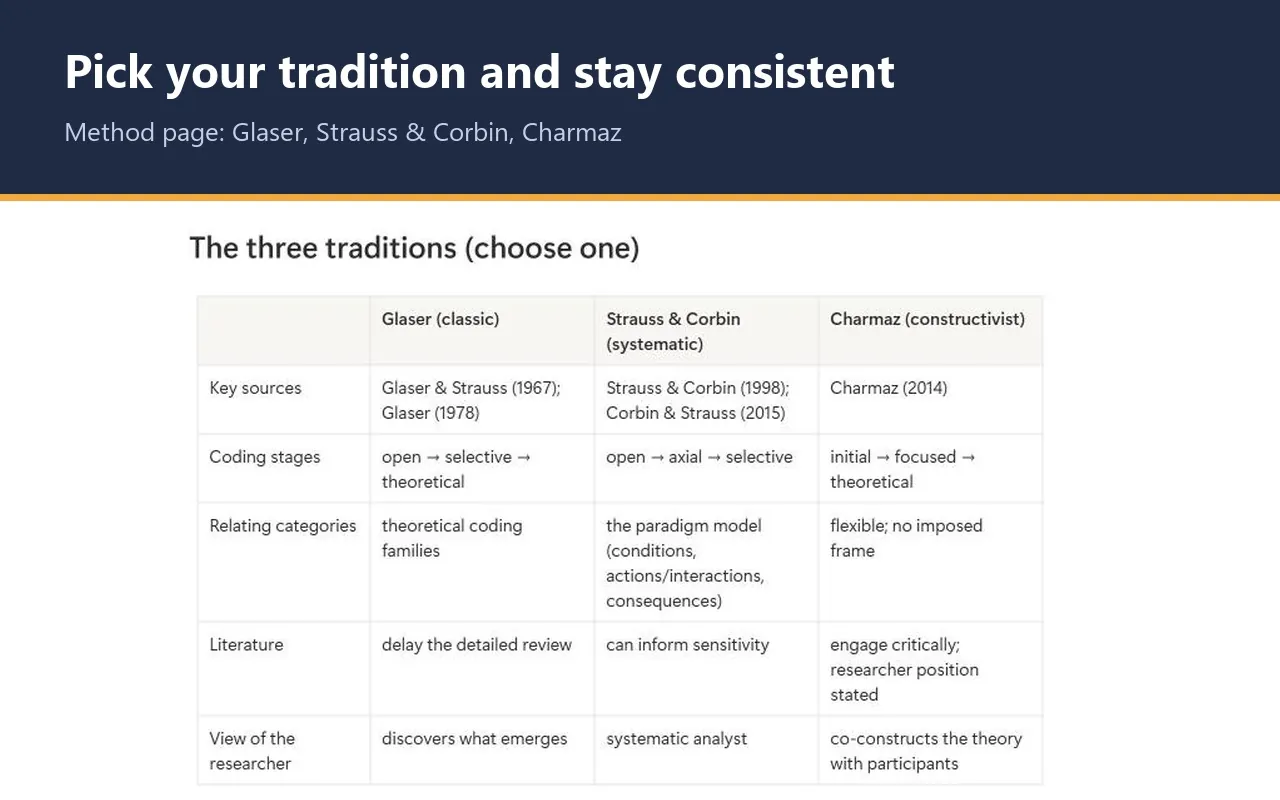
The studio follows the method literature: Glaser & Strauss (1967), Glaser (1978), Strauss & Corbin (1998), Corbin & Strauss (2015), Charmaz (2014), Dey (1999) and Birks & Mills (2015). The core category checks are adapted from Strauss & Corbin's (1998) criteria for a central category.
A method page sets out the three traditions side by side, Glaser, Strauss & Corbin and Charmaz, with their stage names, the role of literature and their quality criteria. A second page explains how grounded theory differs from thematic analysis.
What the studio does not do
- It does not choose your tradition or settle the debate between them. It warns that mixing them is a coherence risk.
- It does not judge the quality of your codes, categories or theory. The signals support your judgement; they do not replace it.
- It does not count confirming cases for you. You count them, so keep the count honest.
- It is not qualitative data analysis software. Keep identifiable transcripts out of any workspace you share.
What you get
- A one-page PDF with your private link, sent by Gumroad straight after checkout. Click it, then Duplicate, and the studio is in your own Notion workspace, yours to keep.
- Simple mode: three steps, one small table each, with a plain instruction above every table. You can start in Notion for the first time today.
- A theoretical sampling log, category saturation, a core category check, a properties and dimensions board, codes by stage and a memo log with a code-to-theory ladder.
- Export views that turn your sampling log, categories, properties, codebook and memos into clean CSV tables for an appendix.
- A Start here page, a method guide with full references, and a worked fictional example you can clear in a few minutes.
- Works on Notion's Free plan. No charts, no paid features and no Notion AI needed.
Questions
Does it suit Glaser, Strauss & Corbin or Charmaz?
All three. The worked example uses Strauss & Corbin, but the coding stage labels are written "Axial / focused" and "Selective / theoretical" so that any tradition can use them, and you can rename them once at the start. Pick one tradition and stay with it. The core category checks are adapted from Strauss & Corbin; Glaser's criteria for a core variable differ, and the method page says so.
Is it the same as the Qualitative Coding Studio?
No. The free Qualitative Coding Studio is for reflexive thematic analysis: themes that answer a research question, from a sample fixed in advance. This studio is for grounded theory: sampling driven by the analysis, saturation by properties, and a core category that integrates the rest.
Will I get updates?
The link in your PDF points to the published studio, so if it is updated you can duplicate the current version again. Your own copy never changes underneath you, which matters halfway through an analysis.
Does it work on Notion's Free plan?
Yes. The studio uses ordinary databases, relations, rollups and formulas. It needs no charts, no paid Notion features and no Notion AI, so the Free plan is enough.
How do I get the studio after I pay?
Checkout is on Gumroad. Straight after you pay $15, you get a one-page PDF with your private link. Open the link, click Duplicate, and the studio is copied into your own Notion workspace. It is yours to keep.
What if the link does not work or something is wrong?
Digital products cannot be returned once delivered, but if the link does not work or something is wrong with the studio, email rafiq@gradsummit.com and we will fix it or refund you.
Can my research group or class use it?
Each purchase is for one person. For a class or research group, email rafiq@gradsummit.com about a group licence.
Related guides and templates
Other research studios
Grounded Theory Studio
Code → Compare → Saturate, with a worked example and a method guide. $15, one-time.
Grounded Theory Studio by Rafiq Muhammad, MD, MIHMEP, PhD (GradSummit). The example study and all its data are fictional and created for teaching.
Notion is a trademark of Notion Labs, Inc. GradSummit is not affiliated with or endorsed by Notion.