A clinical audit template for Notion that closes the loop
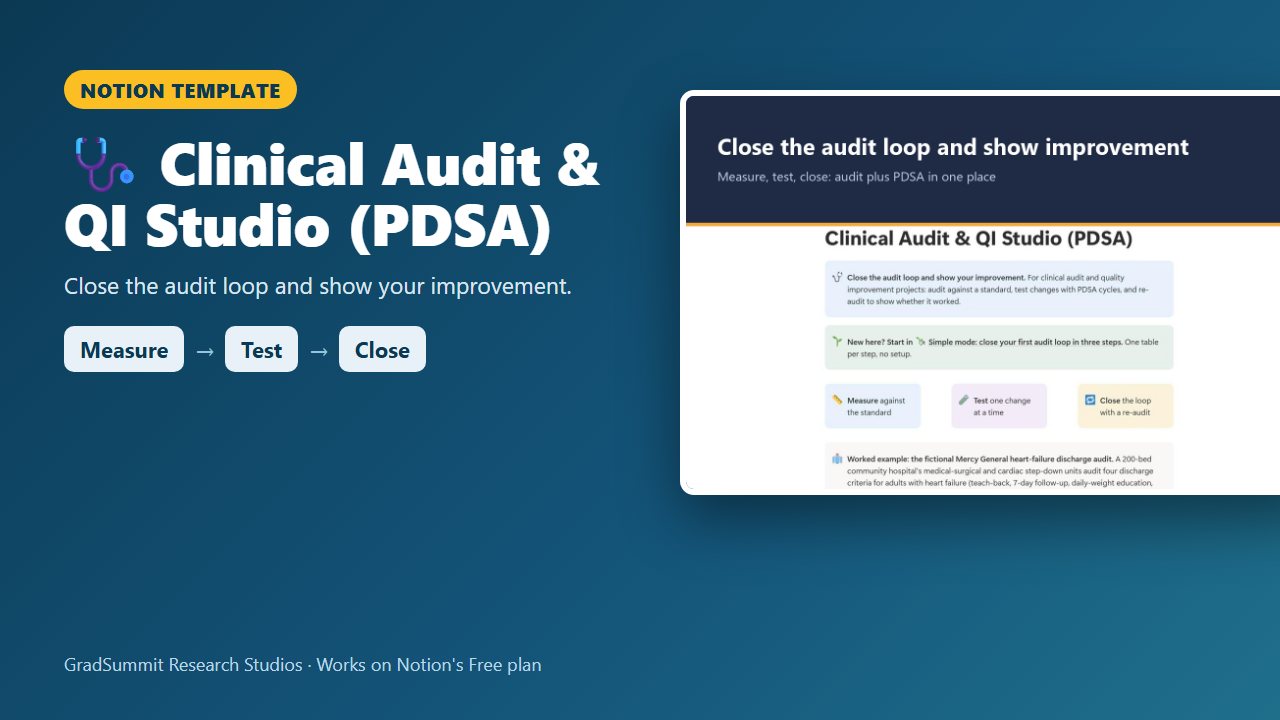
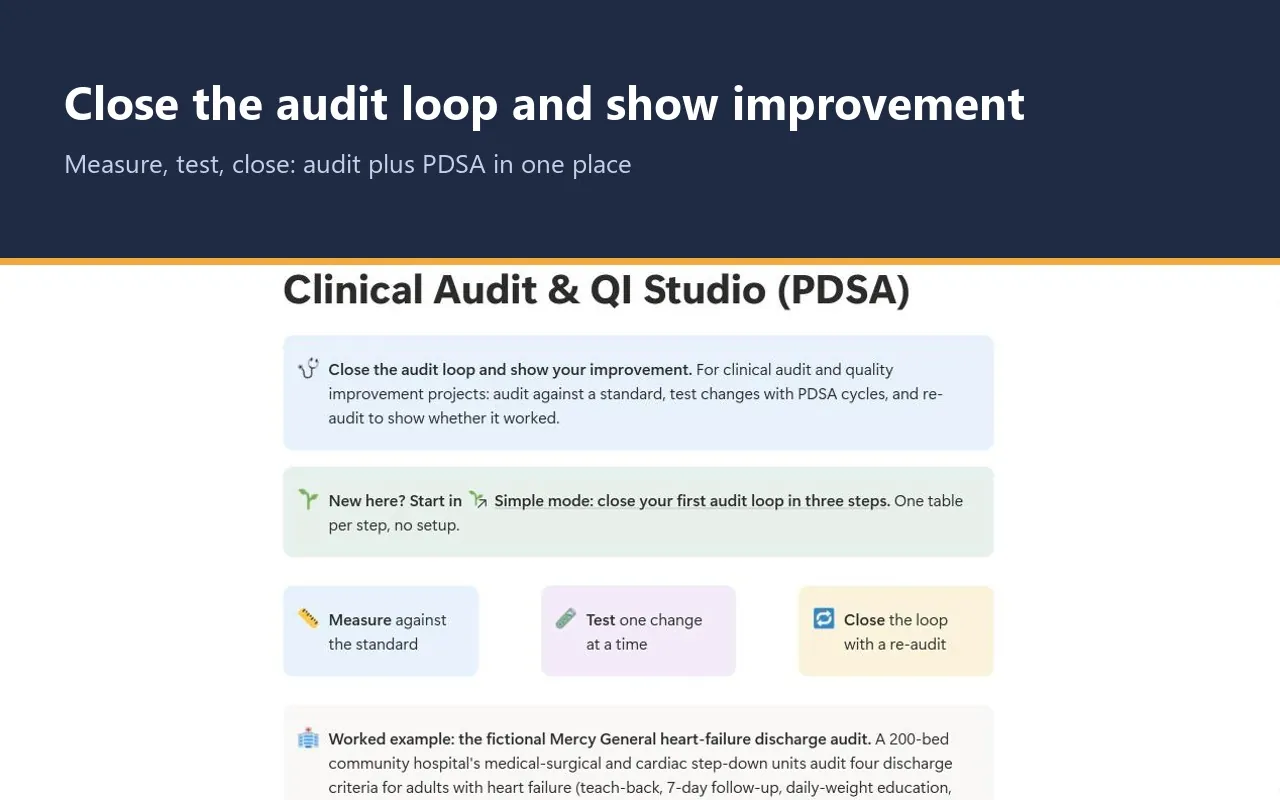
Measure each criterion against its target, test one change at a time as a PDSA cycle, and re-audit, so you can show criterion by criterion whether the audit loop is closed.
For residents, junior doctors, nurses, DNP students and allied health professionals running a clinical audit or quality improvement project for a portfolio, revalidation, a capstone or an audit meeting.
- Measure → Test → Close
- Simple mode
- Works on Notion's Free plan
- Worked example
$15
One-time price. Checkout on Gumroad; an instant PDF with your link to duplicate the studio.
See inside the Clinical Audit & QI Studio (PDSA)
The problem it solves
Most audit projects stall after the first audit. You measure a problem, present it, try a change on the ward, and then rotate. Nobody re-audits, so the loop never closes.
The second gap is the PDSA record. Taylor et al. (2014) found that fewer than one in five published PDSA projects reported a sequence of iterative cycles. Without a prediction written before each test, you have a list of things you tried, not PDSA cycles.
The third gap is the run chart. Supervisors ask for one, and a few good weeks are easily over-read as a shift. This studio keeps criteria, counts, cycles and weekly data together and says plainly where each criterion stands.
How it works: Measure → Test → Close
Measure
Write each criterion with its standard, target and exceptions, then enter your audit counts: eligible cases and compliant cases. Compliance % and Met? fill in by themselves. Counts only, never patient-level data.
Test
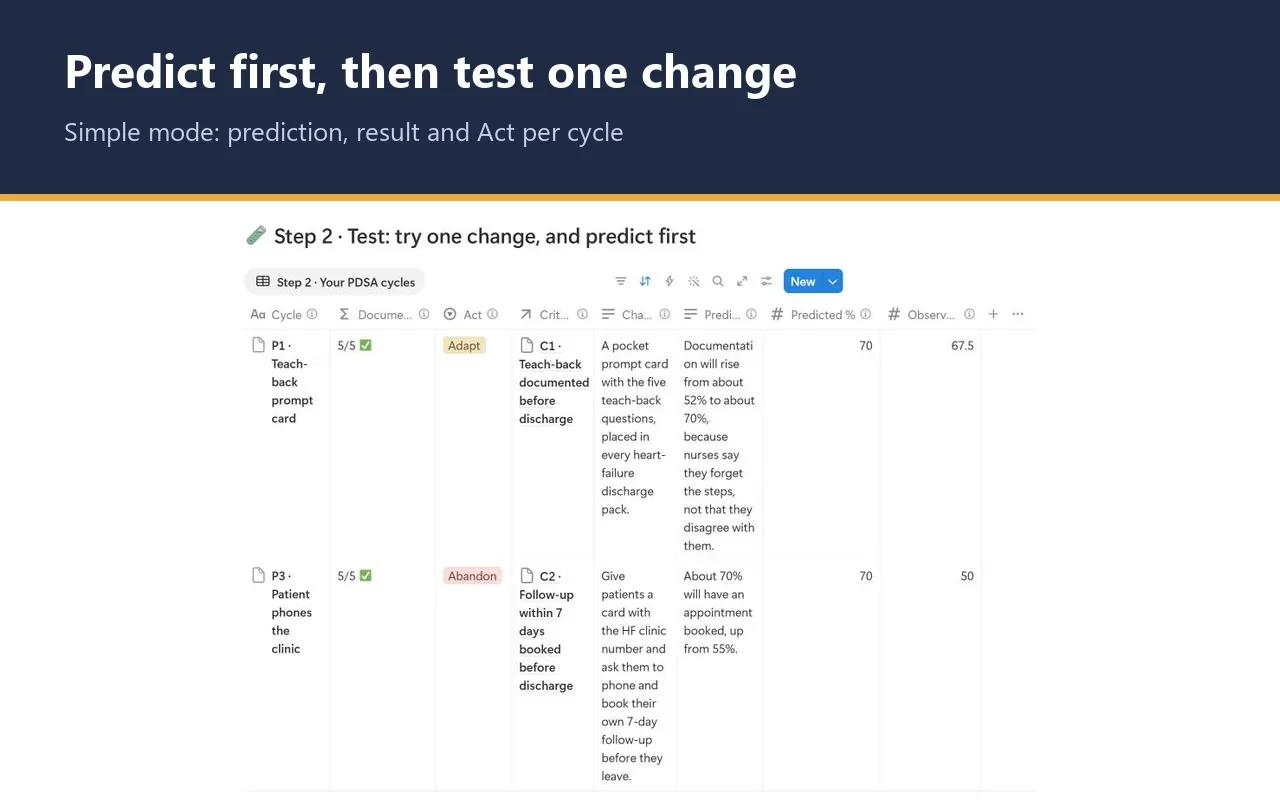
Try one change at a time as a PDSA cycle. Write the plan and a prediction before you test, then what happened and whether you adopt, adapt or abandon the change.
Close
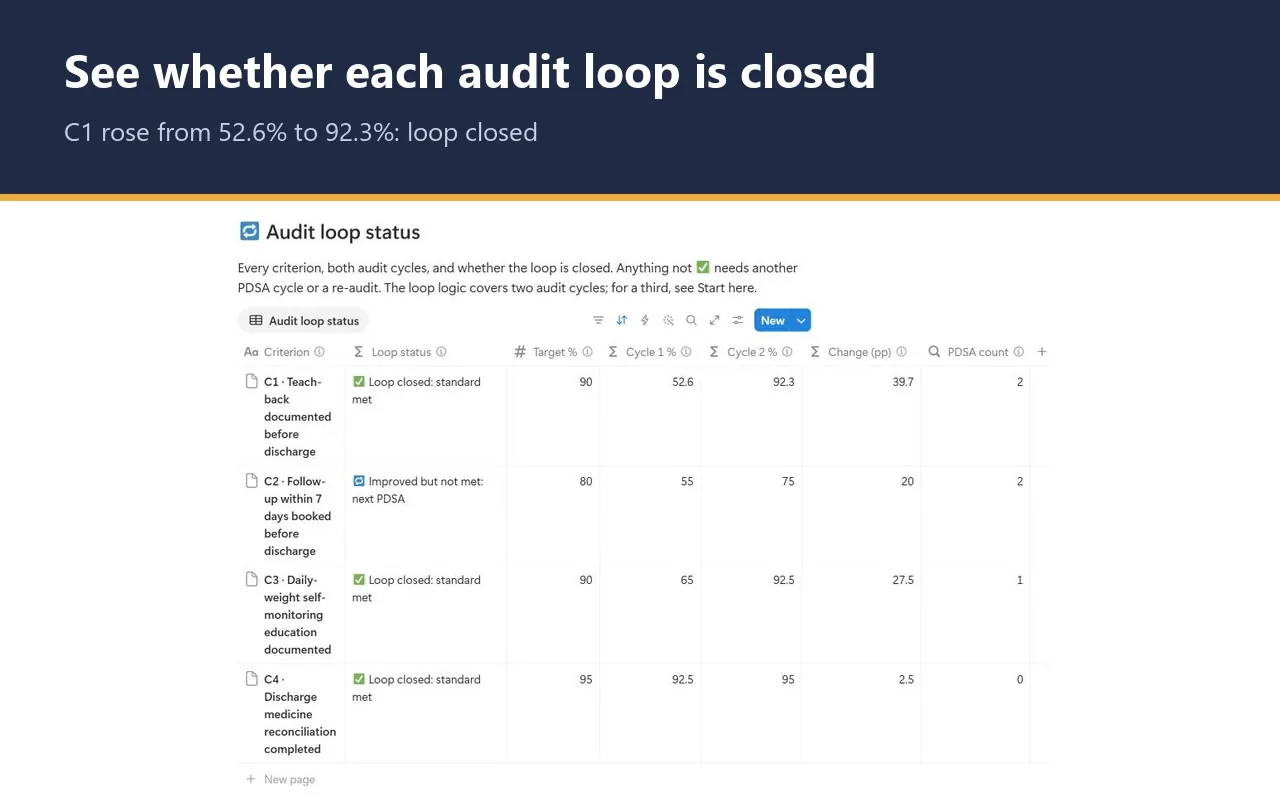
Re-audit the same criteria the same way. Loop status compares Cycle 1 with Cycle 2 for every criterion and tells you which loops are closed, which improved but missed the target, and which need a new idea.
What the studio checks for you
Every criterion, every PDSA cycle and every run of weekly data carries a plain-language status, worked out by formulas from what you enter. These are the main labels.
Loop status, per criterion
- ⚪ Not yet audited: no Cycle 1 measurement yet.
- ⏳ Re-audit due: Cycle 1 is in, Cycle 2 is not.
- ✅ Loop closed: standard met: Cycle 2 compliance meets the target.
- 🔁 Improved but not met: next PDSA: compliance rose, but not to the target.
- 🔴 No improvement: rethink the change: Cycle 2 is no better than Cycle 1.
- ⚠️ Fix the ⚠️ measurement first: a linked measurement has a problem, such as more compliant cases than eligible ones or two Cycle 1 rows for one criterion.
Documented, per PDSA cycle
- 5/5 ✅: plan, prediction, do, study and the reason for your Act decision are all written.
- 4/5 ⚠️ (or lower): parts are missing, or hold a placeholder such as n/a, tbc or "as above", which does not count. It checks that real text is there, not whether the text is good.
Shift signal and runs check, per criterion
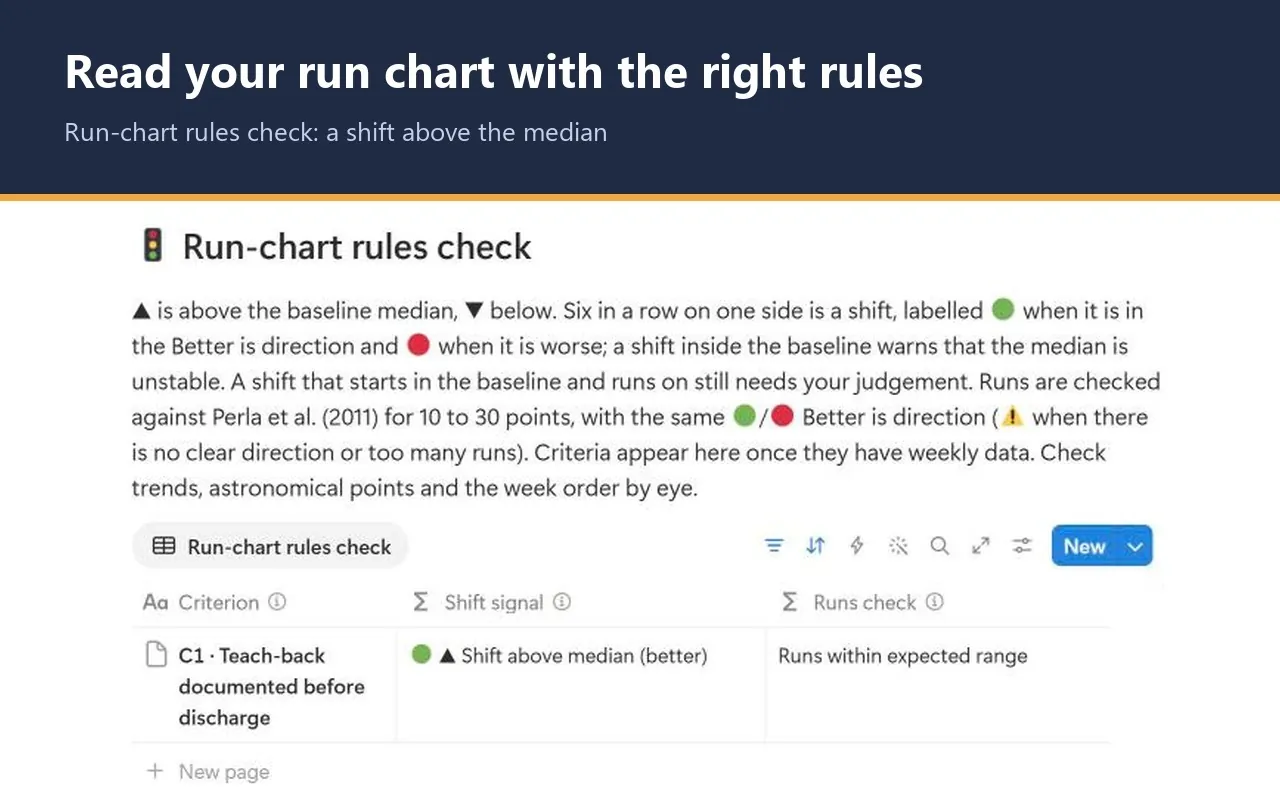
- 🟢 ▲ Shift above median (better): six or more weeks in a row above the baseline median, in the direction you set as better. The 🔴 version flags a shift in the worse direction.
- Runs within expected range: the number of runs sits inside the published limits for your number of useful points (10 to 30).
- Too few or too many runs: labelled 🟢 or 🔴 by direction, or ⚠️ when there is no clear direction or too many runs.
The shift rule and runs limits follow Perla, Provost & Murray (2011). You copy the baseline median once from the table footer, because Notion formulas cannot read other rows. Trends and astronomical points are checked by eye.
The worked example
Fictional study
The worked example is fictional: the Mercy General heart-failure discharge audit in a 200-bed community hospital, with illustrative numbers. It has four criteria, two audit rounds of 40 discharges each, four PDSA cycles and 16 weeks of run-chart data. Teach-back rises from 52.6% to 92.3% and its loop closes; follow-up rises from 55% to 75% against an 80% target, so it shows 🔁. One PDSA cycle is abandoned and one is left at 4/5 on purpose. The run chart shows a shift above a baseline median of 52.25%, with 8 runs in 16 points. Clearing the example takes a few minutes.
Method and sources
The studio follows HQIP's guidance on clinical audit (standard, criteria, measure, change, re-audit), the Model for Improvement and its PDSA cycle (Langley et al., 2009), the evidence on how PDSA is used in practice (Taylor et al., 2014), run-chart rules (Perla, Provost & Murray, 2011) and SQUIRE 2.0 for reporting (Ogrinc et al., 2016). Measure, Test and Close are this studio's shorthand, not formal terms.
A separate page, "Audit, QI or research?", sets out the UK route (the Health Research Authority's categories) and the US route (45 CFR 46.102), and says plainly that your IRB, ethics committee or QI office decides, not the studio.
What the studio does not do
- It does not give clinical advice, and it does not decide whether your project needs ethics review.
- It draws no chart: the run chart is a sorted table and a ▲/▼ sequence. A signal is not proof that your change caused it.
- Loop status compares two audit cycles. A third audit is recorded and checked against its target, but you compare it with the earlier cycles yourself.
- Enter aggregate counts only, never patient-identifiable data, and follow your organisation's audit and information governance rules.
What you get
- A one-page PDF with your private link, sent by Gumroad straight after checkout. Click it, then Duplicate, and the studio is in your own Notion workspace, yours to keep.
- Simple mode: three steps, one small table each, with a plain instruction above every table. You can start in Notion for the first time today.
- Audit loop status, compliance by audit round, PDSA cycles, a run-chart table and rules check, and a decision log.
- Export views that turn your audit summary, measurements, PDSA log and run-chart data into clean CSV tables.
- A Start here page, a method guide with full references, and a worked fictional example you can clear in a few minutes.
- Works on Notion's Free plan. No charts, no paid features and no Notion AI needed.
Questions
Does it handle a third audit cycle?
Partly. You can log a third audit round, and each measurement in it still shows ✅ Met or ❌ Not met against the target, with the round's criteria met count. Loop status compares Cycles 1 and 2 only; Start here shows how to compare a third by hand.
Is my project audit, QI or research?
The studio has a page that explains the difference, with the UK and US routes, and a decision log to record how you classified the project. It does not decide for you. Ask your ethics committee, IRB, R&D or QI office, especially if you plan to publish.
Will I get updates?
The link in your PDF points to the published studio, so if it is updated you can duplicate the current version again. Your own copy never changes underneath you, which matters halfway through an audit cycle.
Does it work on Notion's Free plan?
Yes. The studio uses ordinary databases, relations, rollups and formulas. It needs no charts, no paid Notion features and no Notion AI, so the Free plan is enough.
How do I get the studio after I pay?
Checkout is on Gumroad. Straight after you pay $15, you get a one-page PDF with your private link. Open the link, click Duplicate, and the studio is copied into your own Notion workspace. It is yours to keep.
What if the link does not work or something is wrong?
Digital products cannot be returned once delivered, but if the link does not work or something is wrong with the studio, email rafiq@gradsummit.com and we will fix it or refund you.
Can my research group or class use it?
Each purchase is for one person. For a class or research group, email rafiq@gradsummit.com about a group licence.
Related guides and templates
Other research studios
Clinical Audit & QI Studio (PDSA)
Measure → Test → Close, with a worked example and a method guide. $15, one-time.
Clinical Audit & QI Studio (PDSA) by Rafiq Muhammad, MD, MIHMEP, PhD (GradSummit). The example study and all its data are fictional and created for teaching.
Notion is a trademark of Notion Labs, Inc. GradSummit is not affiliated with or endorsed by Notion.