A journal club template for Notion that changes something
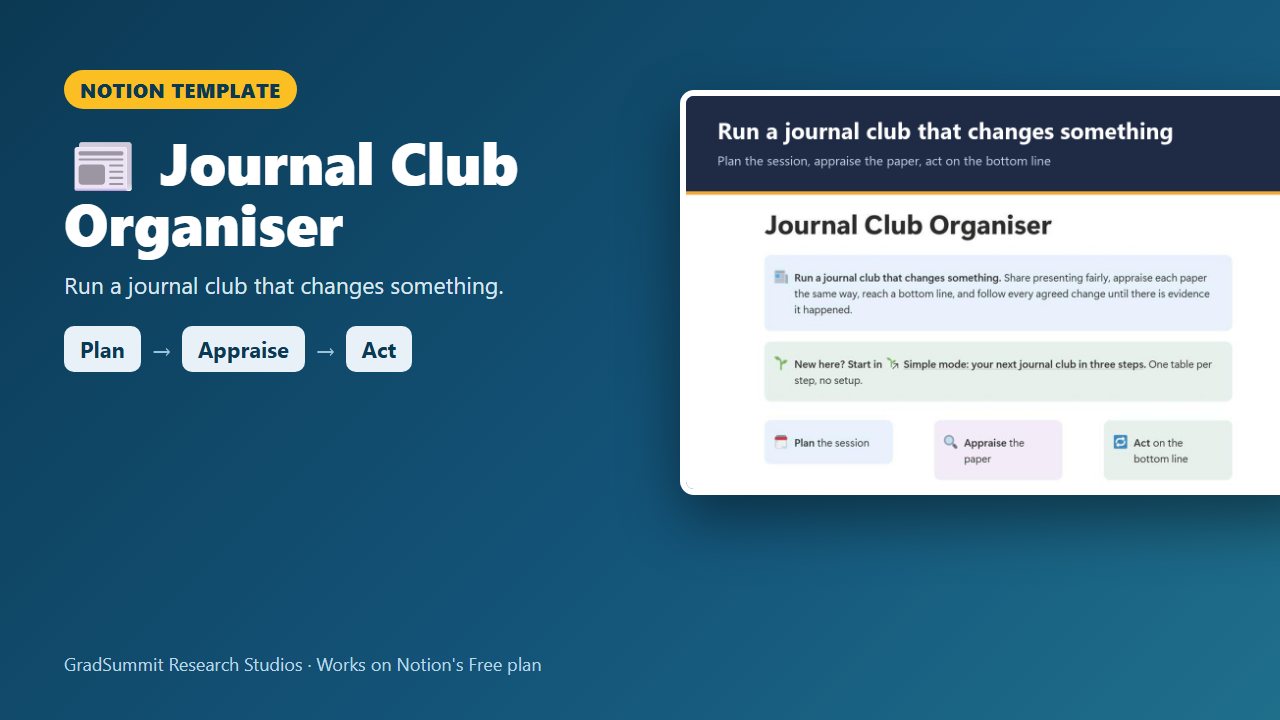
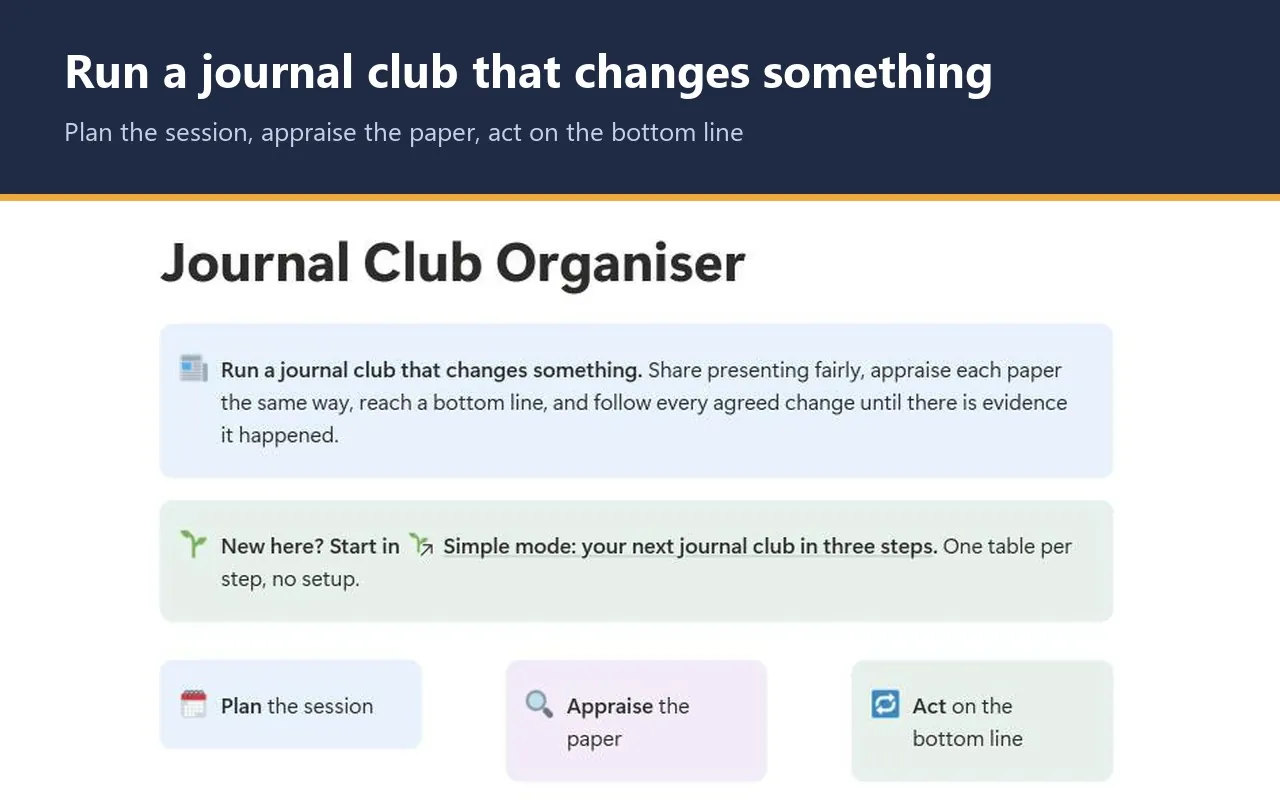
Plan each session, appraise every paper with the same three questions, reach a bottom line, and follow each agreed practice change until it is implemented with evidence or dropped with a reason.
For clinicians, nurse educators, residents and research leads who run a hospital, ward or department journal club, and for academic groups that read papers together.
- Plan → Appraise → Act
- Simple mode
- Works on Notion's Free plan
- Worked example
$12
Not yet available to buy. It is coming soon to Gumroad; this page will show a Buy button as soon as it is listed.
See inside the Journal Club Organiser
The problem it solves
Most journal clubs run on goodwill and a spreadsheet. The same two people present every month. Each presenter appraises in their own way, so one paper gets a full checklist and the next gets a summary of the abstract. And the change everyone agreed in March is never mentioned again.
Most studies in one systematic review reported gains in knowledge and appraisal skills, but none reported whether that learning reached clinical practice (Deenadayalan et al., 2008). The features linked to effective clubs are unglamorous: regular, anticipated meetings, a clear purpose, papers circulated beforehand and a trained leader.
This studio builds those features in. It shares presenting fairly, gives every paper the same three questions, and keeps every agreed change in view until someone can point to evidence that it happened, or a reason it did not.
How it works: Plan → Appraise → Act
Plan
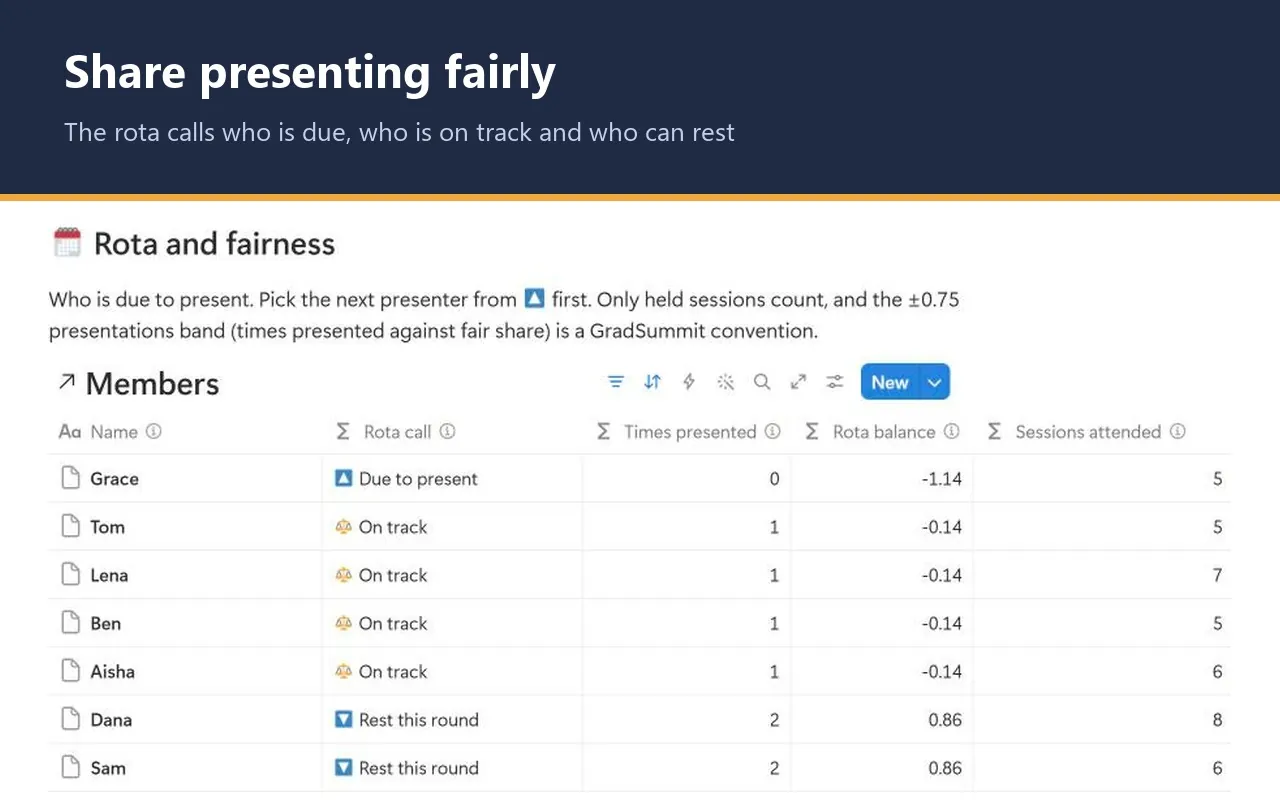
Add each session with its date, presenter and paper. The rota shows who is due to present next, counting only sessions that were actually held.
Appraise
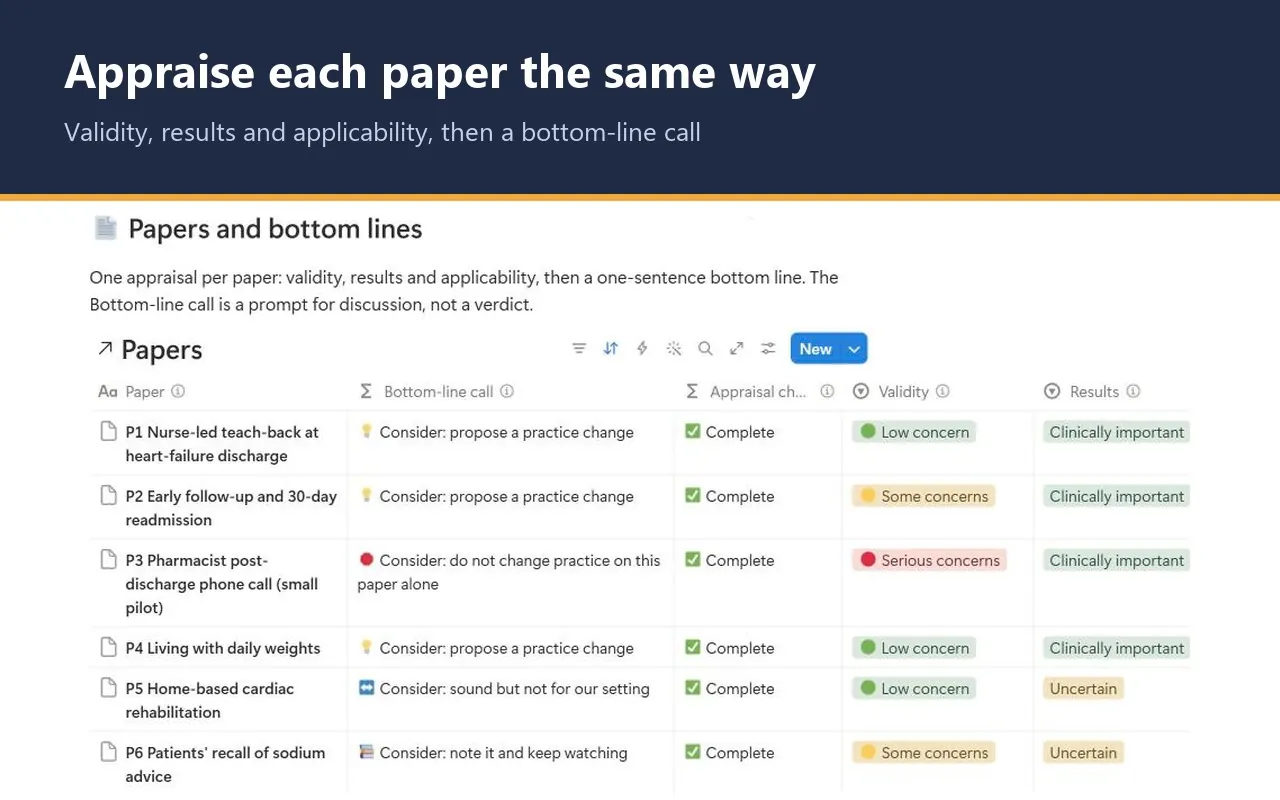
Judge every paper on the same three questions: can we trust the results, do they matter, and do they apply to our patients? Then write a one-sentence bottom line.
Act
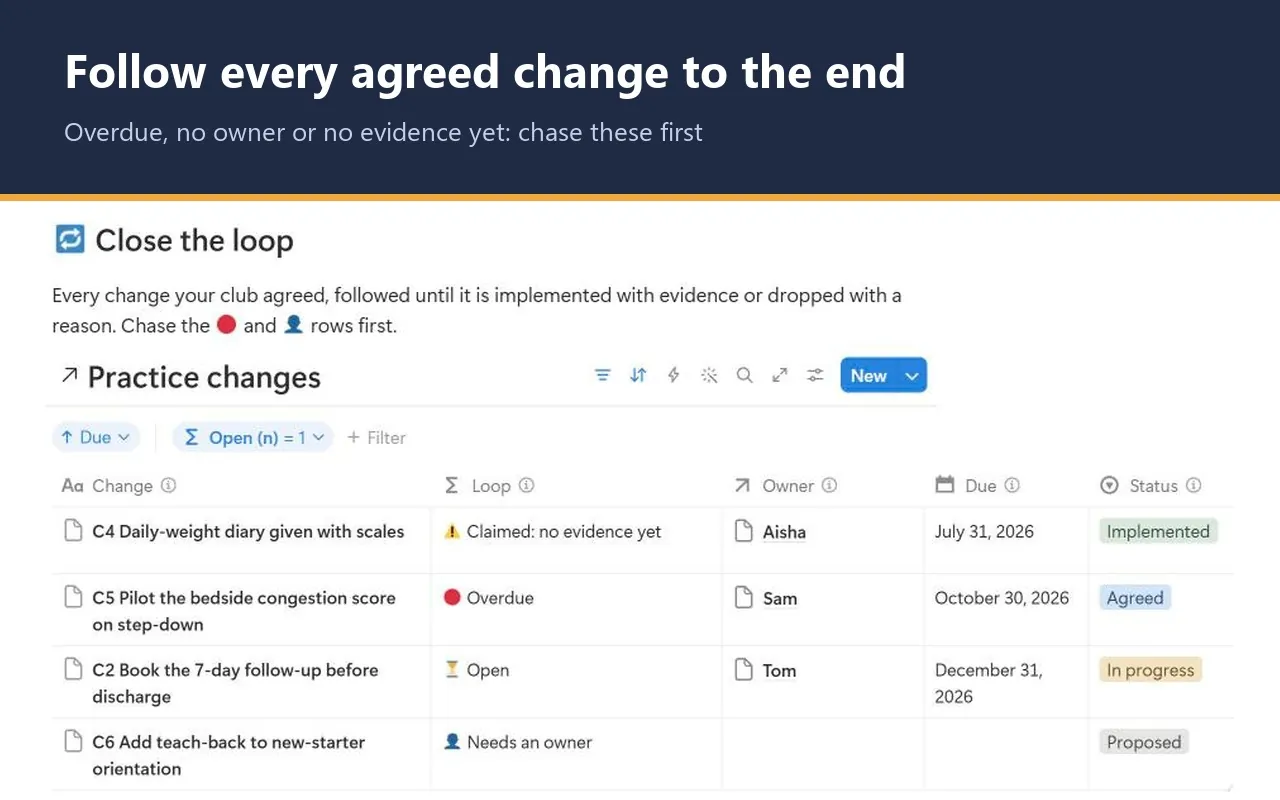
Log each practice change the club agrees, with an owner and a due date, and follow it until it is implemented with evidence or not adopted with a reason.
What the studio checks for you
Members, papers and practice changes each carry a status worked out from what you enter. These are the labels you will see.
Rota call, per member
- 🔼 Due to present: presented 0.75 or more times below their fair share.
- ⚖️ On track: within the band.
- 🔽 Rest this round: presented 0.75 or more times above their fair share.
- 💤 Not on the rota: not marked active.
Bottom-line call, per paper
- ⚪ Appraisal incomplete: one of the three judgements is missing.
- 🛑 Consider: do not change practice on this paper alone: serious validity concerns.
- ↔️ Consider: sound but not for our setting: the results do not apply to your patients.
- 💡 Consider: propose a practice change: the results are clinically important.
- 📚 Consider: note it and keep watching: everything else.
Loop, per practice change
- 👤 Needs an owner: agreed, but nobody is responsible for it.
- ⏳ Open / 🔴 Overdue: in progress, or past its due date.
- ⚠️ Claimed: no evidence yet: marked Implemented with nothing to point to.
- ✅ Loop closed: implemented, with evidence recorded.
- ⬛ Closed: not adopted: dropped, with a reason recorded. 📝 Record why not until there is one.
The ±0.75 rota band and the bottom-line rules are GradSummit conventions, and the studio says so. Every bottom-line call is a prompt for discussion, not a verdict. Override the rota when there is a good reason, such as pairing a new starter with an experienced presenter.
The worked example
Fictional study
The worked example is fictional: the Mercy General cardiac step-down multidisciplinary journal club. It has 8 members, 7 of them active, 11 sessions of which 8 were held, 9 papers and 6 practice changes. Fair share is about 1.14 presentations: Grace, who has not presented, shows 🔼, and two members who have presented twice show 🔽. Two of the six changes are closed, so the loop-closing rate reads 33% (2 of 6). The rest show ⏳, 🔴, 👤 and ⚠️, so you can see each loop status. Clearing the example takes a few minutes.
Method and sources
The three questions follow the classic structure of the Users' Guides to the Medical Literature (Guyatt et al., 2015). For the detailed questions on each design, the studio links to the official CASP, JBI and CEBM checklists rather than reproducing them, and records which one the presenter used.
The method page also sets out what reviews of journal clubs found (Ebbert et al., 2001; Deenadayalan et al., 2008; Harris et al., 2011), how the fair rota is calculated, and what counts as evidence that a change happened: an audit result, a revised protocol or a training record, not "we think people are doing it".
What the studio does not do
- It is not a critical appraisal tool. Use the official checklist for each study design for the detailed questions.
- It records whether agreed changes happened. It cannot show that the club caused them, or that patients benefited.
- To measure whether a change is working, run a clinical audit or a quality-improvement cycle.
- The example is fictional and is not clinical guidance.
What you get
- Once it is on sale: a one-page PDF with your private link, sent by Gumroad straight after checkout. Click it, then Duplicate, and the studio is in your own Notion workspace, yours to keep.
- Simple mode: three steps, one small table each, with a plain instruction above every table. You can start in Notion for the first time today.
- Close the loop, rota and fairness, papers and bottom lines, a learning-point archive with attendance and CPD minutes, and Club at a glance with a loop-closing rate.
- Export views that turn your sessions, appraisals and practice changes into clean CSV tables for a report or a CPD portfolio.
- A Start here page, a method guide with full references, and a worked fictional example you can clear in a few minutes.
- Works on Notion's Free plan. No charts, no paid features and no Notion AI needed.
Questions
Does it replace CASP?
No. CASP, JBI and CEBM checklists give the detailed questions for each study design, and the studio links to them. What it adds is the same three top-level judgements for every paper, a one-sentence bottom line, and a record of what the club agreed to do about it.
Does it work for an academic or research-group journal club?
Yes. The rota, the session log and the paper appraisals work for any group that reads papers together. The practice-change log suits clinical clubs best, but a research group can use it for agreed changes to its own methods.
Will I get updates?
The link in your PDF points to the published studio, so if it is updated you can duplicate the current version again. Your own copy never changes underneath you, which matters halfway through a year of sessions.
Does it work on Notion's Free plan?
Yes. The studio uses ordinary databases, relations, rollups and formulas. It needs no charts, no paid Notion features and no Notion AI, so the Free plan is enough.
When can I get it, and how?
It is not on sale yet. It is coming soon to Gumroad at $12, and this page and the Notion templates page will show a Buy button as soon as it is. After checkout you will get a one-page PDF with your private link. Open the link, click Duplicate, and the studio is copied into your own Notion workspace.
What if the link does not work or something is wrong?
Digital products cannot be returned once delivered, but if the link does not work or something is wrong with the studio, email rafiq@gradsummit.com and we will fix it or refund you.
Can my research group or class use it?
Each purchase is for one person. For a class or research group, email rafiq@gradsummit.com about a group licence.
Related guides and templates
Other research studios
Journal Club Organiser
Plan → Appraise → Act, with a worked example and a method guide. Coming soon, $12 one-time.
Journal Club Organiser by Rafiq Muhammad, MD, MIHMEP, PhD (GradSummit). The example study and all its data are fictional and created for teaching.
Notion is a trademark of Notion Labs, Inc. GradSummit is not affiliated with or endorsed by Notion.