A literature synthesis matrix for Notion that counts
Log what each paper shows about each concept in your framework, see which concepts are empty, thin or contested, and write synthesis statements that each draw on two or more papers.
For master's and doctoral students writing the literature review chapter of a thesis or proposal, with somewhere between a dozen and a hundred papers to pull together.
- Extract → Spot → Synthesise
- Simple mode
- Works on Notion's Free plan
- Worked example
$12
One-time price. Checkout on Gumroad; an instant PDF with your link to duplicate the studio.
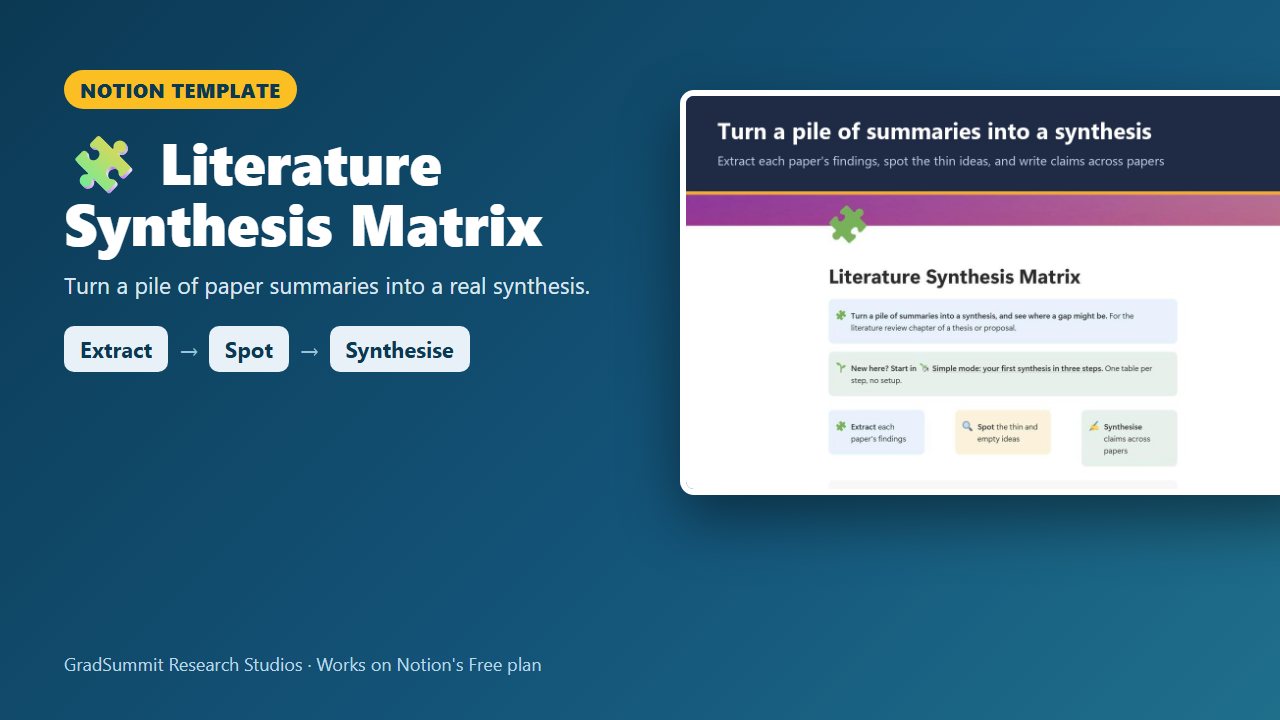
See inside the Literature Synthesis Matrix
The problem it solves
"This is a list of summaries, not a synthesis." It is the most common comment on a first literature review draft, and it is hard to act on. You have read the papers. You have notes on each one. The chapter still reads paper by paper: Smith found this, Jones found that.
The fix is to organise the review around concepts rather than authors (Webster & Watson, 2002). A synthesis sentence says what several papers show together, where they agree, where they conflict and why (Torraco, 2005). That is hard to do from a folder of notes, because the notes are filed by paper.
Gaps have the same problem. "No study has looked at X" is a strong claim, and supervisors know that a gap is often just the edge of what you have read. A gap needs to be argued, not just declared (Sandberg & Alvesson, 2011).
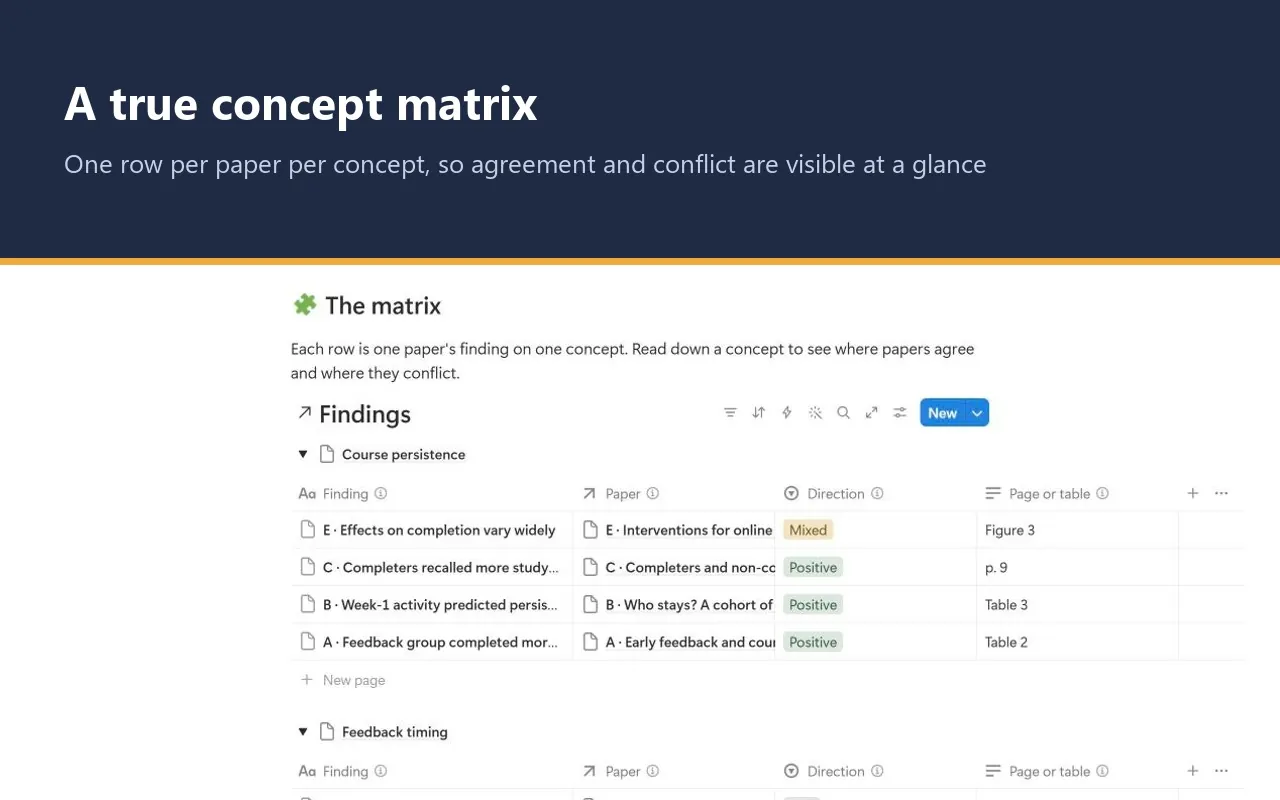
This studio turns your reading into a concept matrix that counts: how many papers speak to each concept, how strong they are, whether they agree, and whether each claim you write rests on more than one paper.
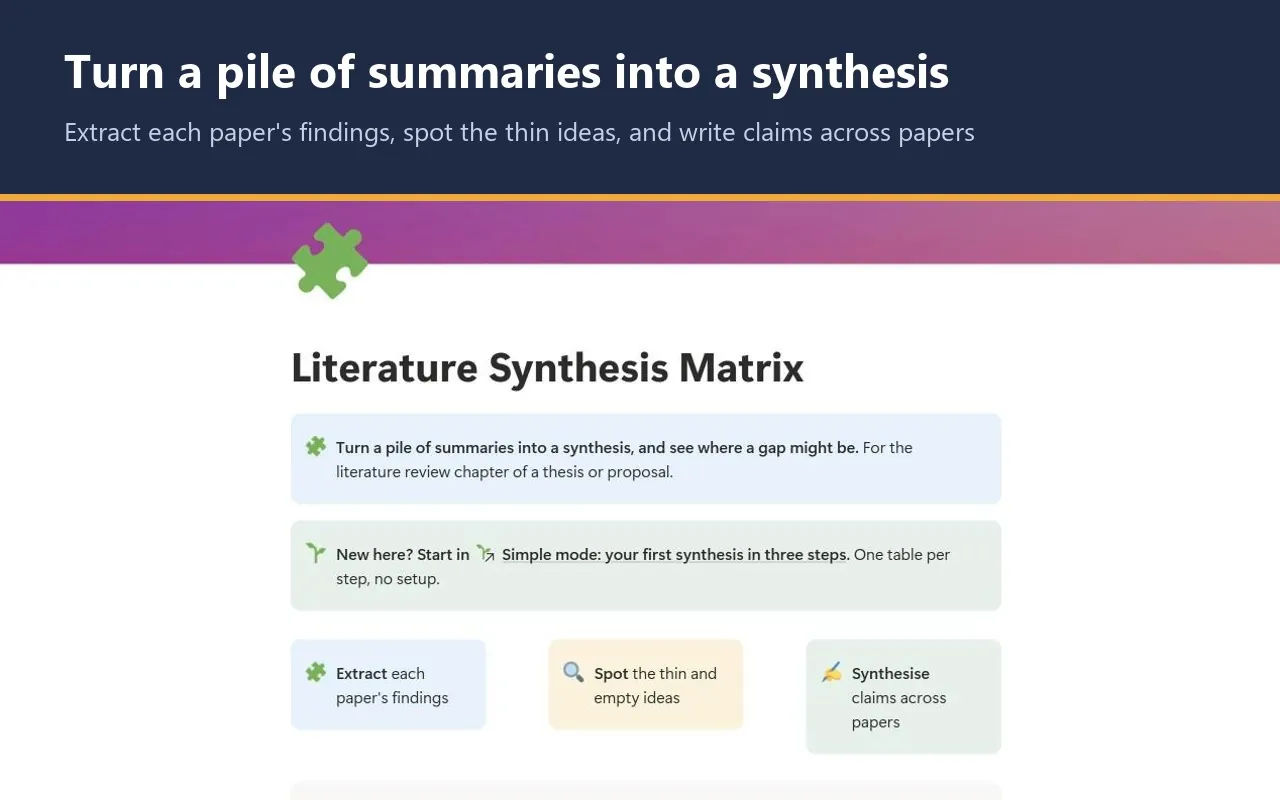
How it works: Extract → Spot → Synthesise
Extract
List the concepts in your framework first, from your research questions. Then log one finding per paper per concept, with its direction (positive, negative, null or mixed) and the page or table it came from.
Spot
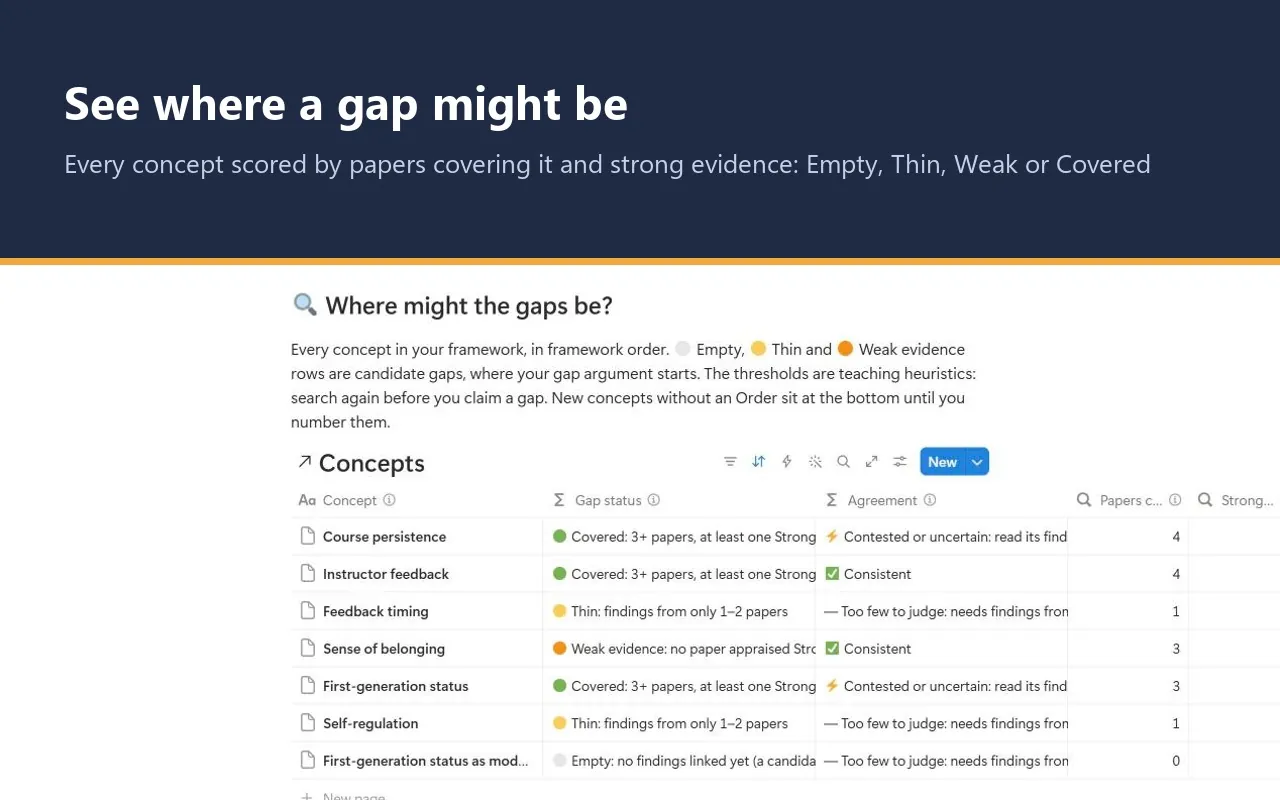
Read the gap meter. Every concept shows how many papers cover it, whether any is appraised Strong, and whether the papers agree. Concepts with no findings still show as rows, so candidate gaps are visible before you write.
Synthesise
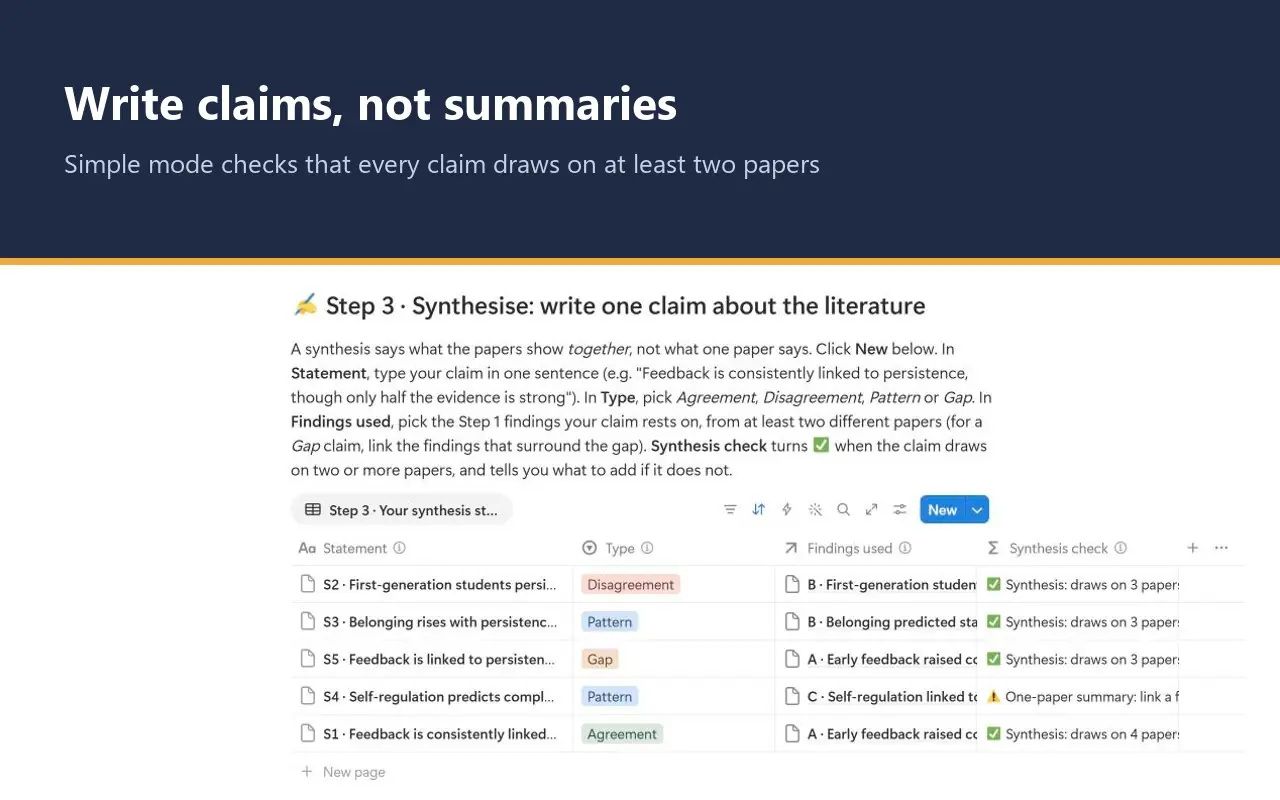
Write each claim as a synthesis statement: an agreement, a disagreement, a pattern or a gap. Link the findings it rests on. The studio checks that it draws on two or more papers.
What the studio checks for you
Each concept and each synthesis statement carries a plain-language status, worked out by formulas from your findings and appraisals. The labels begin like this, then say in words what to do next.
Gap status, per concept
- ⚪ Empty: no findings linked yet: a candidate gap, if your search was thorough.
- 🟡 Thin: findings from only one or two papers.
- 🟠 Weak evidence: three or more papers, but none appraised Strong.
- 🟢 Covered: three or more papers, at least one appraised Strong.
Agreement, per concept
- — Too few to judge: findings from fewer than two papers.
- ✅ Consistent: the papers point the same way.
- ⚡ Contested or uncertain: the directions conflict, or at least one finding is null or mixed. A null result means uncertainty, not necessarily conflict, so read the findings.
Synthesis check, per statement
- ⚠️ One-paper summary: the statement rests on a single paper: it is still a summary.
- ✅ Synthesis: it draws on two or more papers, and says how many.
Your paper appraisals (Strong, Moderate or Weak) feed the gap meter, so three weak studies do not look settled. The thresholds (one to two papers is thin, at least one Strong paper to count as covered) are teaching heuristics, not a published standard, and the studio says so. Empty means empty in your matrix, not in the world: search again before you claim a gap.
The worked example
Fictional study
The worked example is the fictional literature behind the Brookfield thesis: instructor feedback, course persistence and first-generation students in online programmes. It has 8 papers of different designs, 7 concepts, 16 findings and 5 synthesis statements. The gap meter shows 3 concepts 🟢 Covered, 2 🟡 Thin, 1 🟠 Weak evidence (belonging: three papers, none Strong) and 1 ⚪ Empty: whether first-generation status moderates the feedback link. Four statements show ✅ Synthesis; one, on self-regulation, is deliberately left as ⚠️ One-paper summary so you can see the check work. Clearing the example takes a few minutes.
Method and sources
The studio follows Webster & Watson (2002) for the concept-centric review and the concept matrix, Torraco (2005) for writing integrative synthesis, and Sandberg & Alvesson (2011) on gap-spotting and problematisation, so a gap is argued rather than declared.
The method page sets out the difference between an author-by-author and a concept-by-concept review, how to read the gap meter, and how to turn a statement into a paragraph. Extract, Spot, Synthesise is GradSummit's shorthand, not a published method.
What the studio does not do
- It does not appraise papers for you. Record an appraisal from your own appraisal tool or checklist.
- It does not find gaps. It shows where your matrix is empty or thin; whether that is a real gap is your argument to make.
- It does not write your review. Statements are one-sentence claims you expand in your own words.
- It is not a reference manager. Keep your references in Zotero, EndNote or similar.
What you get
- A one-page PDF with your private link, sent by Gumroad straight after checkout. Click it, then Duplicate, and the studio is in your own Notion workspace, yours to keep.
- Simple mode: three steps, one small table each, with a plain instruction above every table. You can start in Notion for the first time today.
- The matrix grouped by concept, the gap meter, synthesis statements with their check, and papers by stage with their appraisal.
- Four export views that turn your evidence matrix, gap table, synthesis statements and papers into clean CSV tables for an appendix.
- A Start here page, a method guide with full references, and a worked fictional example you can clear in a few minutes.
- Works on Notion's Free plan. No charts, no paid features and no Notion AI needed.
Questions
Is this the same as a synthesis matrix in a spreadsheet?
It is built on the same idea, papers against concepts, but each cell is a row with its direction and page, and the studio counts them. For how a synthesis matrix works in general, read the synthesis matrix guide; this studio is for running one across a whole review.
Can I use it for a systematic review?
It suits the synthesis stage of a narrative or integrative review best. A systematic review needs a registered protocol, a screening record and formal appraisal with the official tools; the Scoping & Systematic Review Manager and the Critical Appraisal Studio cover those parts.
Will I get updates?
The link in your PDF points to the published studio, so if it is updated you can duplicate the current version again. Your own copy never changes underneath you, which matters halfway through a literature review.
Does it work on Notion's Free plan?
Yes. The studio uses ordinary databases, relations, rollups and formulas. It needs no charts, no paid Notion features and no Notion AI, so the Free plan is enough.
How do I get the studio after I pay?
Checkout is on Gumroad. Straight after you pay $12, you get a one-page PDF with your private link. Open the link, click Duplicate, and the studio is copied into your own Notion workspace. It is yours to keep.
What if the link does not work or something is wrong?
Digital products cannot be returned once delivered, but if the link does not work or something is wrong with the studio, email rafiq@gradsummit.com and we will fix it or refund you.
Can my research group or class use it?
Each purchase is for one person. For a class or research group, email rafiq@gradsummit.com about a group licence.
Related guides and templates
Other research studios
Literature Synthesis Matrix
Extract → Spot → Synthesise, with a worked example and a method guide. $12, one-time.
Literature Synthesis Matrix by Rafiq Muhammad, MD, MIHMEP, PhD (GradSummit). The example study and all its data are fictional and created for teaching.
Notion is a trademark of Notion Labs, Inc. GradSummit is not affiliated with or endorsed by Notion.