“Great guide to start planning your scientific questions and determining if the question is worth investigating. … This helped me immensely with developing future directions for my work.”
Read on Amazon →Home › Shop › Finding the question and planning › The Research Question & Problem Statement Workbook
For students choosing and shaping a thesis topic
You have a topic. Turn it into a study.
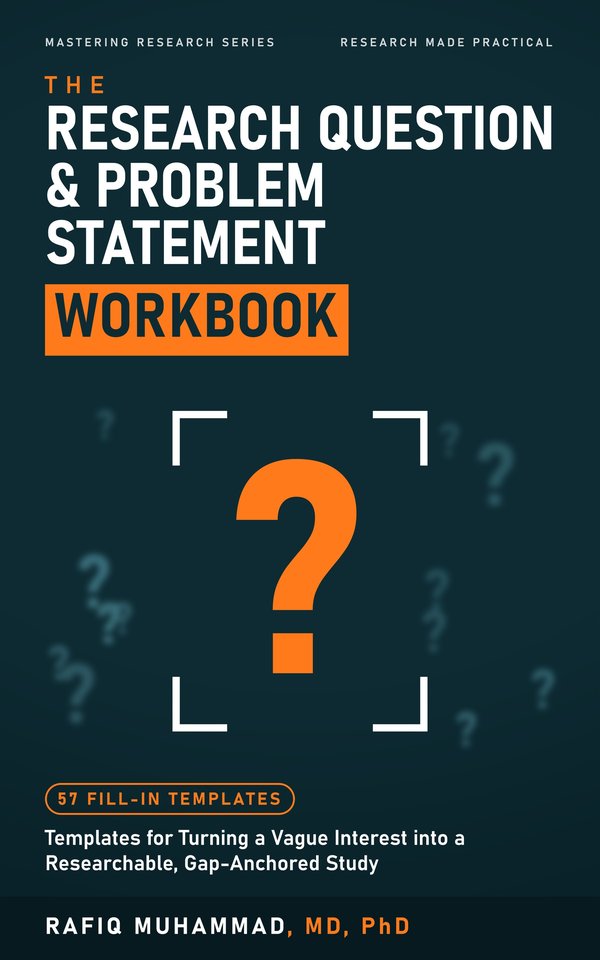
The Research Question & Problem Statement Workbook
The distance between "I'm interested in this" and "here is my answerable, significant study" is where months disappear. This workbook closes it one decision at a time: 57 fill-in templates, with one study worked from a vague interest to an aligned design beside the blanks.
- Narrow a broad interest into one workable angle
- Name your gap and write a problem statement that holds
- Prove that problem, purpose, questions and method line up
By Dr. Rafiq Muhammad, MD, PhD · 167 pages · Examples from nursing, pharmacy, psychology, business and social work · Paperback $27.00 · ★★★★★ 2 reader reviews
What readers say
Reader reviews
★★★★★ 2 reader reviews from Amazon
“This is a great resource for someone who has research to conduct. It covers a variety of different research paths.”
Read on Amazon →Sound familiar?
Where early proposals stall
“I have a topic I care about. I don't have a study.”
“My supervisor keeps saying it's too broad.”
“I can't say what the gap is in one sentence.”
“My problem, purpose and questions don't quite line up, and I can't see why.”
Almost every graduate student hits this wall. It isn't a lack of ideas; it is a missing process: a set of decisions taken in order, each one on its own page, so the study holds together when your committee reads it.
How it works
Narrow. Name the gap. Align.
Three moves, each built on the one before.
Narrow
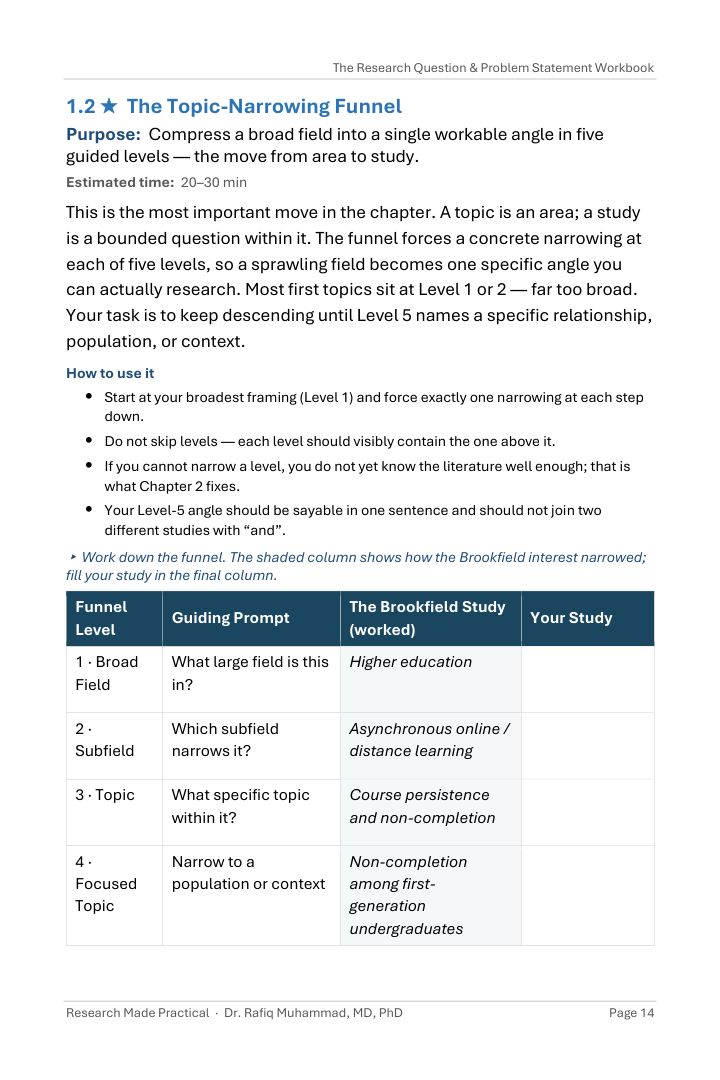
Take a broad interest down a five-level funnel to one workable angle.
Name the gap
Scan the literature, say what is missing, and show why it matters.
Align
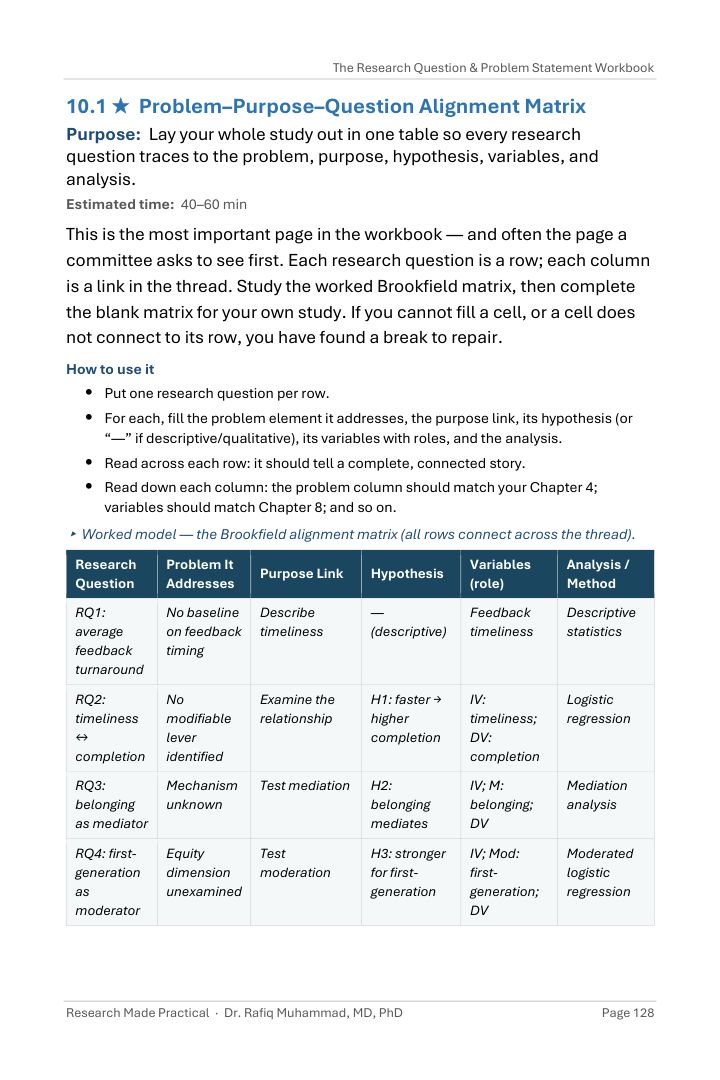
Tie problem, purpose, questions, variables and analysis together in one matrix.
What you will have
What you will have by the last page
- One workable angle, narrowed from a broad interest
- A documented literature scan of the conversation you are joining
- Your gap, its type, and why it matters
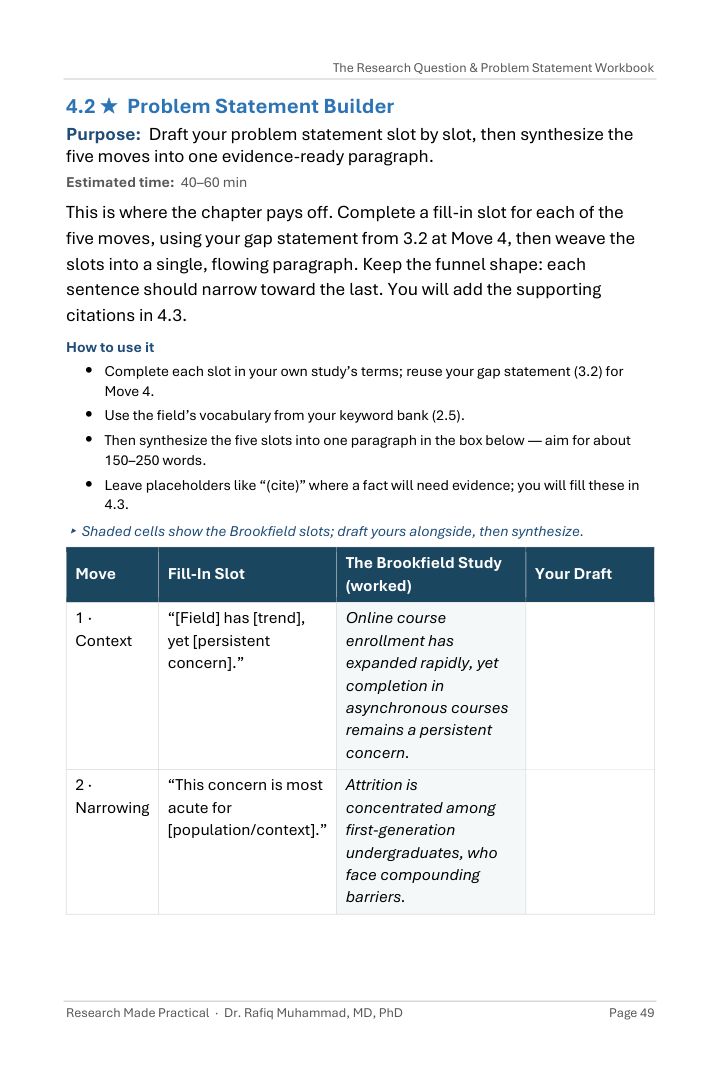
- A problem statement in five moves, with evidence behind every claim
- A purpose statement for a quantitative, qualitative or mixed-methods study
- Research questions, screened for quality, and hypotheses where you need them
- Every variable defined twice: what it means and how you will measure it
- One alignment matrix, a one-page summary and a thirty-second pitch
Look inside
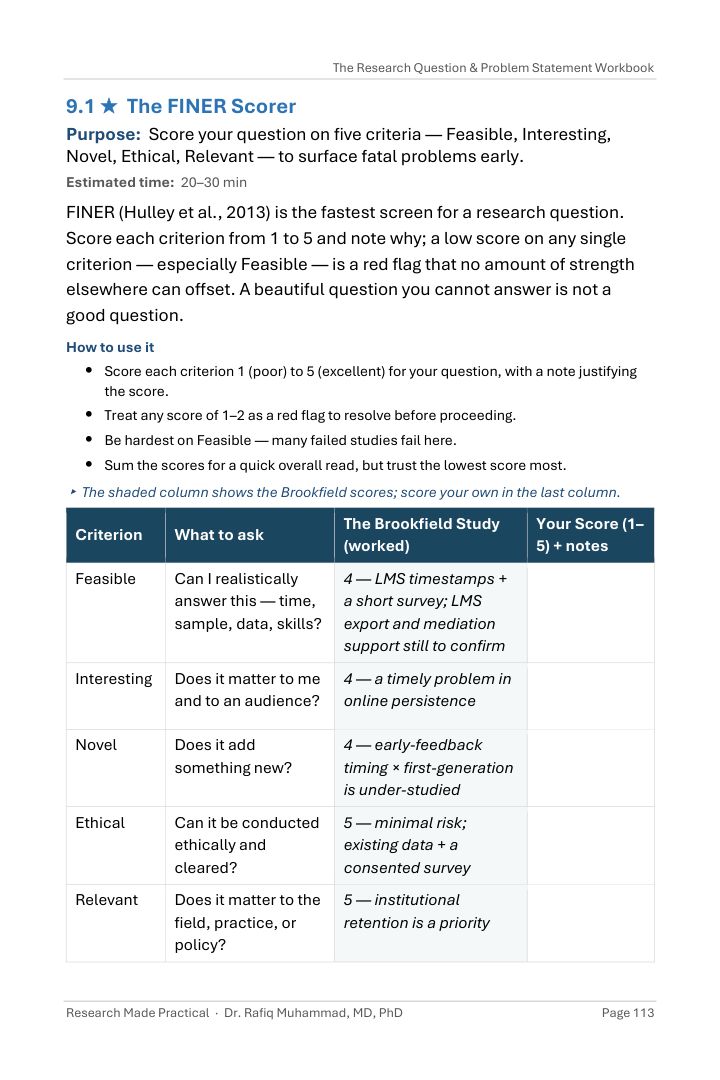
Every template comes with a worked example
One decision per page, with one fictional study worked beside the blanks so you see each step done before you do your own. These are real pages. Tap to enlarge.
Is it for you?
Built for the start of a thesis
It is for you if
- You are a master's or doctoral student choosing and shaping a topic
- You are a professional-doctorate candidate (EdD, DNP, DBA) preparing a proposal
- You supervise and want a structured process to hand to your students
It is not
- A guarantee that a topic or proposal will be approved
- A replacement for your supervisor, committee or ethics board
- Another textbook about research. It is a working surface.
Choose your format
Ways to get it
Paperback
- The same 167 pages in print
- Write in it by hand
- Shipped by Amazon
Research Question & Problem Statement Kit
- Every fill-in template, as a fillable PDF
- Type, save and print; US Letter and A4
Not ready to buy? Get the free toolkit for finding the question and planning by email and start today. Get it free
Questions
Before you buy
My field isn't education. Will it fit?
Yes. The worked study runs through the book, and examples from nursing, pharmacy, psychology, business and social work show the same process in other fields.
Is it for quantitative or qualitative studies?
Both. You draft a purpose statement and research questions for a quantitative, qualitative or mixed-methods study, and test hypotheses only where you need them.
Can I use it with my supervisor?
Yes. Every template has a supervisor sign-off line, and every chapter ends with a checkpoint naming what to bring to your advisor.
Will my proposal be approved?
No book can promise that. This one gives you the structure to arrive at those conversations prepared.
What comes after this one?
The design: The Sample Size & Power Analysis Workbook for a quantitative study, or the methods workbooks in the shop.
Don't just know what a good research question is
Write one, test it, and align a study around it.
Choose your formatMore for this stage: everything for finding the question and planning · the free toolkits