“The step-by-step G*Power walkthroughs and explanations of effect sizes help make topics that can otherwise feel overwhelming more manageable. I also appreciate the focus on sample size justification, which is an important part of developing a solid research methodology.”
Read on Amazon →Home › Shop › Designing the study and collecting data › The Sample Size & Power Analysis Workbook
For students writing a quantitative or mixed-methods proposal
"How many participants do I need?" Derive it. Defend it.
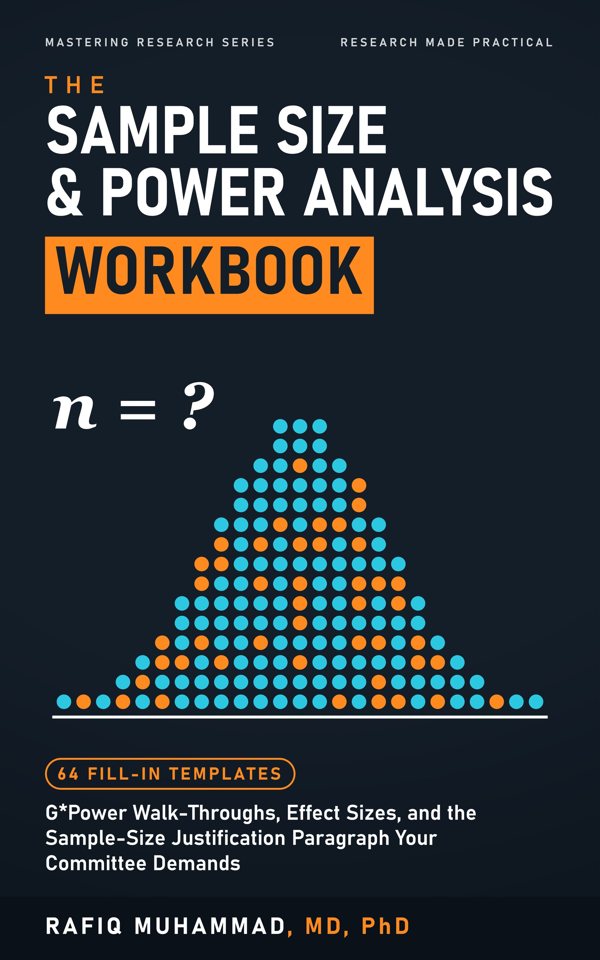
The Sample Size & Power Analysis Workbook
Most students guess, then a committee member or an ethics board asks where the number came from. This workbook is the working surface for the calculation: 64 fill-in templates on large pages, and three studies worked from the first effect-size estimate to the finished justification paragraph.
- An effect size you can source, with a sensitivity range
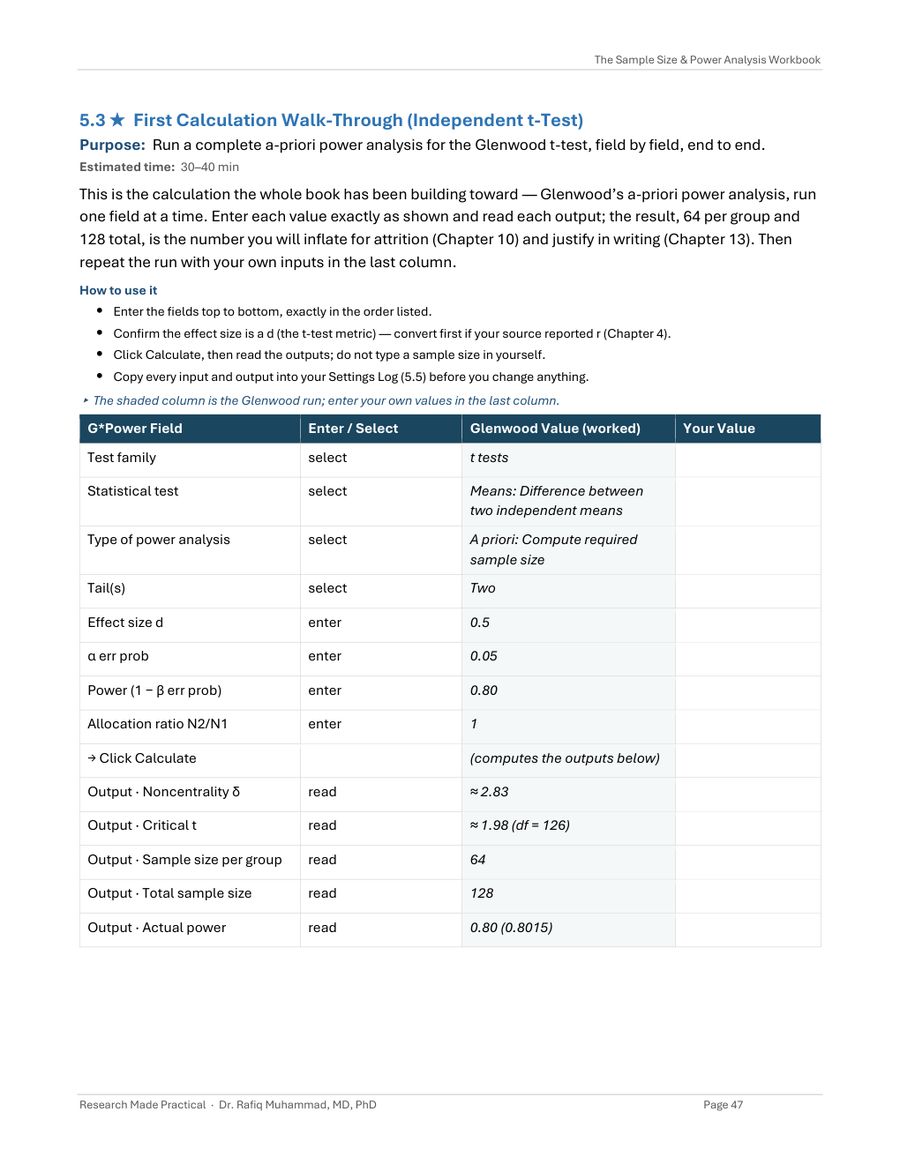
- G*Power run field by field, and every output explained
- The sample-size paragraph for your proposal, ethics application and grant
By Dr. Rafiq Muhammad, MD, PhD · 129 pages · Large 8.5 × 11 in pages · Paperback $32.99 · ★★★★★ 1 reader reviews
What readers say
Reader reviews
★★★★★ 1 reader review from Amazon
Sound familiar?
A sample size is not a guess
“How many participants do I actually need?”
“My committee asked where the number came from, and I didn't have a good answer.”
“I picked a round number because that's what other studies seemed to use.”
“G*Power gave me a number. I can't explain how it got there.”
It is a number you derive from four linked parameters, then justify in writing. Once you can show the effect size, the error rates and the power behind it, the question from your committee stops being a threat and becomes a paragraph.
How it works
Estimate. Compute. Justify.
From an effect size you can source to a paragraph a reviewer can check.
Estimate the effect
From the best evidence you can find, with a sensitivity range, not a hopeful guess.
Compute and inflate
Run the power analysis field by field, then allow for attrition and the people you must screen.
Justify it in writing
The paragraph for your proposal, your ethics application and your grant.
What you will have
What you will be able to do
- Choose the right kind of power analysis, and know why "observed power" isn't one
- Match your design to the right test and the inputs that test needs
- Estimate an effect size from evidence and report a sensitivity range
- Run a calculation in G*Power field by field and read every number it returns
- Use a power sheet for t-tests, ANOVA, ANCOVA, correlation, regression, chi-square and proportions
- Recognise the designs G*Power can't size (clustered data, mediation, SEM, equivalence) and where to take them
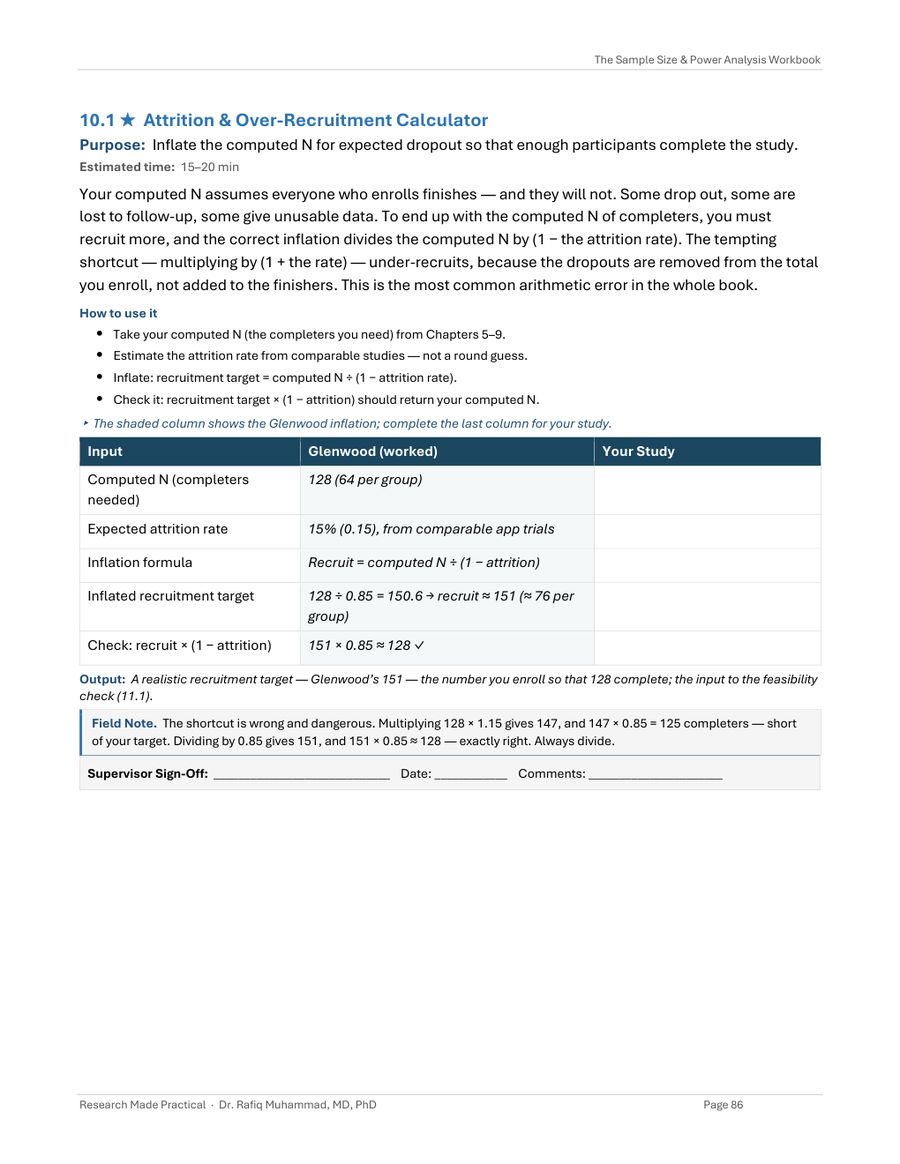
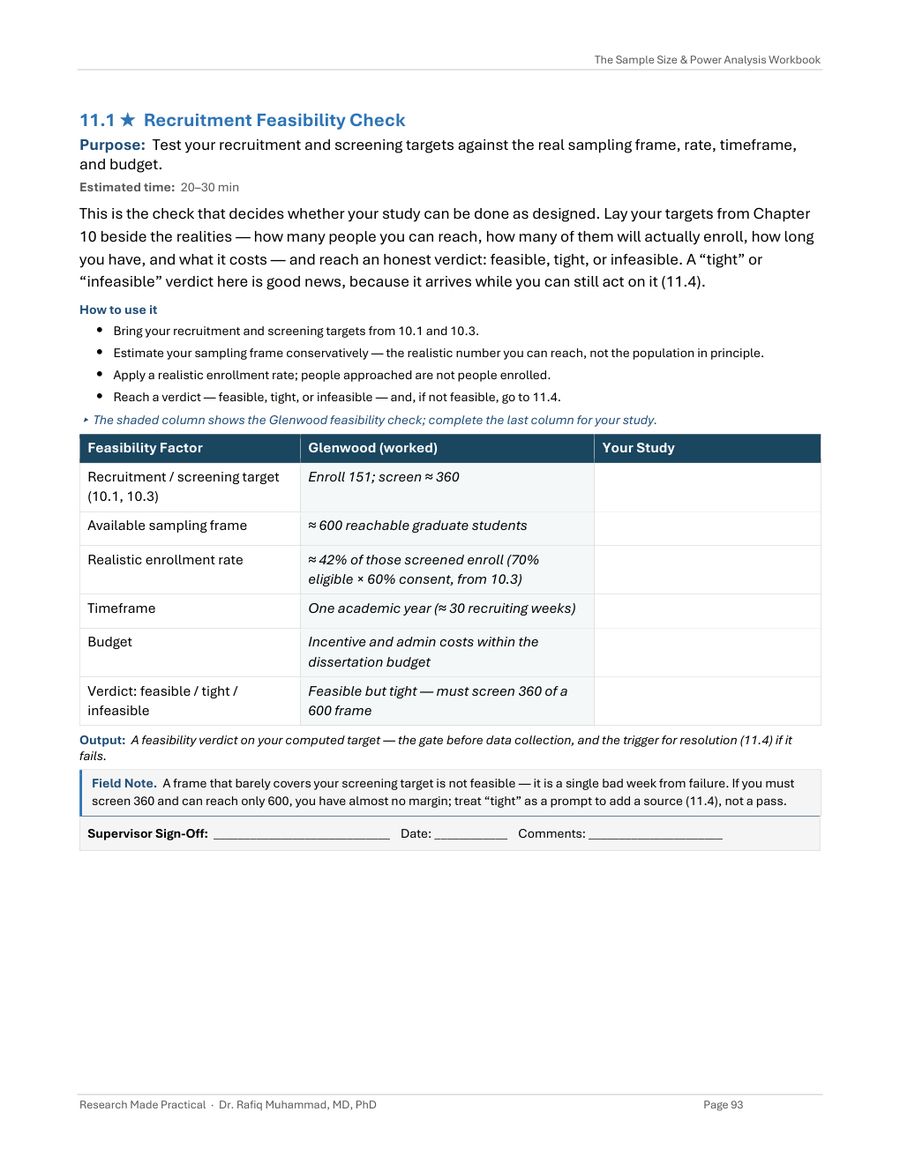
- Inflate for attrition, work back to how many people you must screen, and check you can recruit them
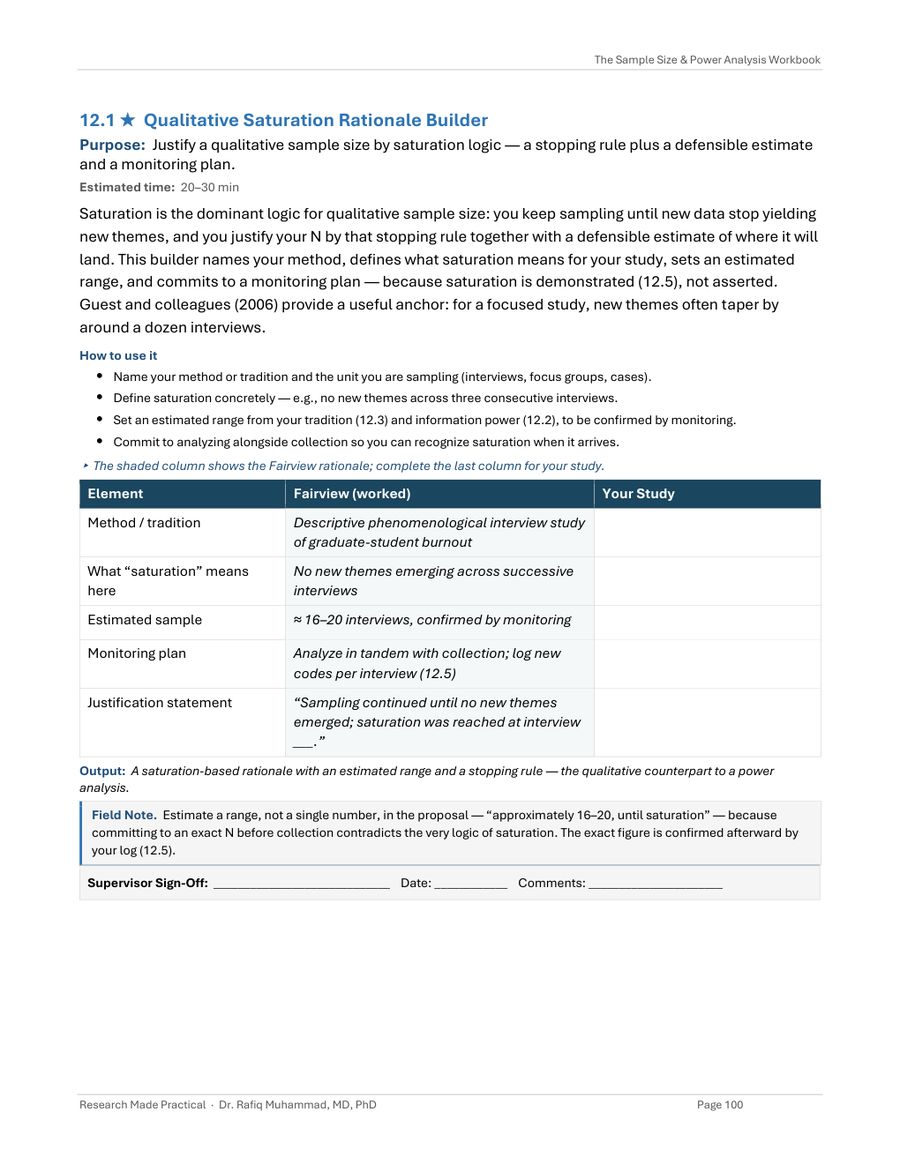
- Justify a qualitative or mixed-methods sample by saturation and information power
Look inside
Every template comes with a worked example
Every worked number is shown, so you can reproduce the figure before you trust your own. These are real pages; tap to enlarge. These are real pages. Tap to enlarge.
Is it for you?
Built for the sample-size section
It is for you if
- You are writing a quantitative or mixed-methods proposal
- You work in health, nursing, psychology, education or the social sciences
- You supervise and want a student's sample-size reasoning laid out step by step
It is not
- A statistics textbook. It is a working surface for doing the calculation.
- A replacement for a statistician on complex or high-stakes designs
- Affiliated with G*Power, which is free software you download yourself
Choose your format
Ways to get it
Paperback
- The same 129 pages in print
- Write in it by hand
- Shipped by Amazon
Sample Size & Power Analysis Template Kit
- Every fill-in template, as a fillable PDF
- Type, save and print; US Letter and A4
Not ready to buy? Get the free toolkit for designing the study and collecting data by email and start today. Get it free
Questions
Before you buy
Do I need G*Power?
It is free software from Heinrich-Heine-Universität Düsseldorf, and the book walks you through it field by field. The book is independent of its developers; you download the program yourself.
My study is qualitative. Is this for me?
Partly. Chapter 12 shows how to justify a qualitative or mixed-methods sample by saturation and information power. If your study is wholly qualitative, that chapter is the part you need.
My design is clustered, or uses mediation or SEM.
The book shows how to recognise the designs G*Power cannot size and where to take them. For complex or high-stakes designs, use a statistician.
Are the worked studies real?
No. The three worked studies are invented to demonstrate the method. Check every figure in current software for your own study.
Will I get a paragraph I can use?
Yes. The final chapter builds the sample-size paragraph for your proposal, your ethics application and your grant.
I only need the justification, fast.
The Sample Size & Power Analysis Template Kit has every template from this workbook as a fillable PDF, including the justification paragraph templates: $19, instant download. The workbook adds the teaching and a completed example of each.
Stop guessing the number
Derive it, inflate it for the real world, and write the paragraph that proves it.
Choose your formatMore for this stage: everything for designing the study and collecting data · the free toolkits